Discover the Secret Life of… Spitfires and Hurricanes

RAF Museum London Hurricane

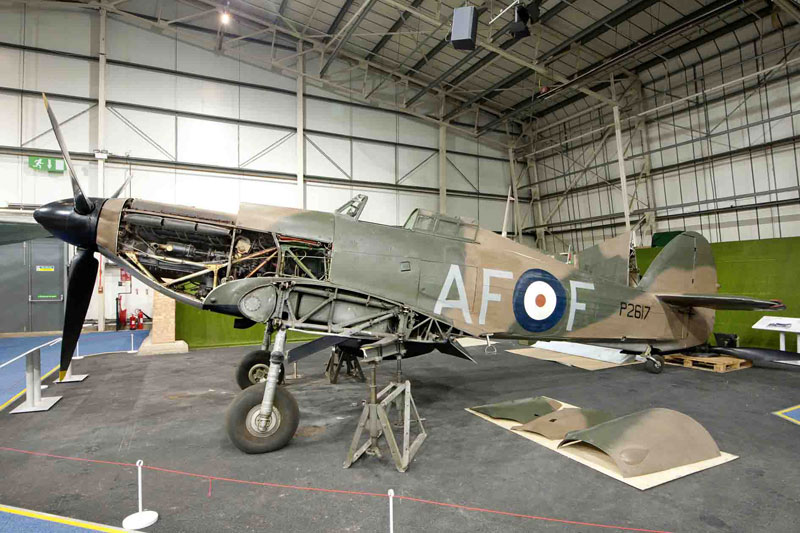
The RAF Museum is offering enthusiasts and visitors a rare chance to get ‘under the skin’ of some of their iconic Battle of Britain aircraft.

The Museum is conducting an ‘open’ condition survey of its aircraft as part of its on-going plans to commemorate and celebrate the RAF’s Centenary in 2018.

The first of these surveys is now underway in the Battle of Britain Hall at its London site and will last until November. During this time visitors will be able to see under the skin of some of the aircraft as panels are removed and parts are dismantled for a closer inspection.

For the first time ever, the Museum is enabling visitors to see the ‘nuts and bolts’ under the panels as qualified technicians asses each aircraft and is also encouraging public photography and filming of the process.

Watch this video: www.rafmuseum.org.uk/london/whats-going-on/news/london-museum-aircraft-survey-announced/

If you would like to learn more about the Museum’s plans for the RAF Centenary in 2018 please sign up to our RAF Centenary Programme e-Newsletter. To do this, just go to the bottom of any page on our main website www.rafmuseum.org, and click on the e-Newsletter link.

Last Chance for Nightshoot Photography Event Tickets at Yorkshire Air Museum

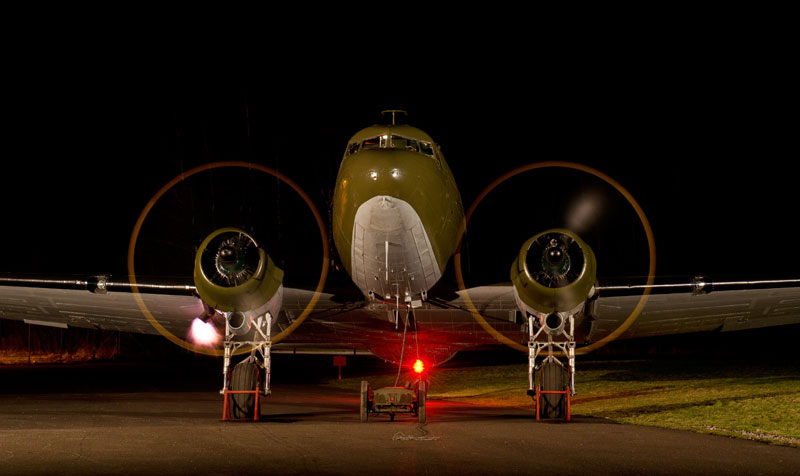
Douglas DC3

Following the huge success of the first Halifax bomber Nightshoot on March 2015, the Museum is delighted to announce another opportunity to photograph this iconic WWII bomber outdoors at night on the evening of Friday 18th March this year.

The timing of this event also allows us to mark the 75th anniversary of the first operational flight of the then brand new Halifax Mk I bomber, from nearby RAF Linton on Ouse on the night of 9th/10th March 1941. The Halifax went on to become one of the main aircraft of Bomber Command, taking the fight to the NAZI German industrial heartland.

The Museum’s amazing reconstruction, the only example in Europe and one of only two existing in the world, is of course marked in the decals of Halifax LV907 “Friday the 13th”, which became the most successful of all Halifax bombers surviving at least 128 missions, flying from RAF Lissett, East Yorkshire. Demand for this event is high once again and there are only a handful of tickets now remaining available, as the sales are strictly limited to 100.

As if this was not enough, the Nightshoot also offers the chance to photograph the WWII Douglas Dakota (live), the 1947 De Havilland Devon and, uniquely, the replica WWI Royal Aircraft Factory SE5a fighter, also live. The Dakota and SE5a will both be running their engines on the night, making for a truly tempting photographic challenge.

“As a result of the great success of last year’s Halifax Nightshoot, which was oversubscribed by enthusiastic photographers relishing the chance to capture this awesome aircraft in a night setting, we decided to offer another opportunity this year, which will not be repeated for a few years. The additional line up of aircraft, including the rare ‘live’ example of a WWI fighter, in the confines of this historic site, will provide a really interesting challenge for photography enthusiasts to get to grips with.”

The Nightshoot is bookable through www.timelineevents.org at £60 per ticket to include two hot drinks and a Burger / Hot Dog & Chips.

www.yorkshireairmuseum.org

Major Shackleton Repaint Being Planned

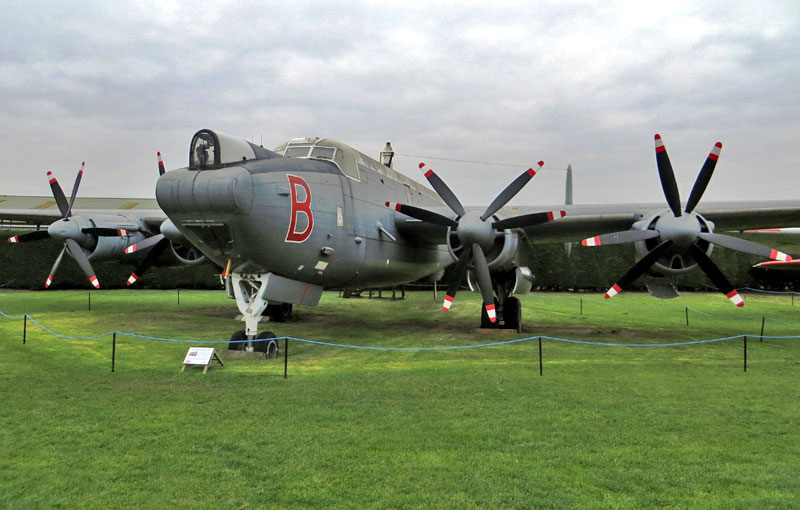
Shackleton

It has been announced by the Newark Air Museum that at the beginning of April it will be embarking on one of the most ambitious repainting projects it has ever undertaken; on Avro Shackleton WR977. This will be carried out with major support of the aircraft’s owners, the Lincolnshire’s Lancaster Association’

Unlike previous repainting work on museum aircraft, scaffolding work platforms will be installed around the Shackleton. This will allow the de-corroding, rubbing down and repainting to be carried out is a safe and efficient manner.

The current plan is to install scaffolding around half of the Shackleton and to focus the work effort on this section of the aircraft. Once the work has been completed the scaffolding will be repositioned on the other side of the aircraft, where the balance of the work will be completed.

To support this work programme and to minimise the length of time that the scaffolding is on hire, the museum has launched an appeal for volunteers; with the aim of working on the project as and when the weather allows, seven days a week. Details of the appeal can be found in the News & Events section of the Newark Air Museum website www.newarkairmuseum.org 

Avro Shackleton WR977 was moved from RAF Finningley in spring 1977, just prior to Her Majesty the Queen’s Silver Jubilee Review of the Royal Air Force. WR977 is believed to be the longest serving Shackleton Mk3 Phase 3 airframe to have flown with the RAF.

Sywell Aviation Museum Grand Opening

Sywell Aviation Museum

Saturday 26th March 2016

Easter Saturday is the traditional Grand Opening for the Sywell Aviation Museum’s new season and this year the event returns bigger and better than ever before! Military vehicles, re-enactors, aircraft cockpits and some surprise aerial visitors (maybe even a warbird or two) make it a fun day out!

The event starts at 1030hrs and runs until 1630hrs. Parking is extremely limited so please arrive early and car share!

Following the Grand Opening the Museum will be open as usual every weekend and bank holiday from 1030-1630hrs until the end of September. In July, August and September, the Museum opens on Wednesday afternoons between 1330-1630hrs.

Entry is free – donations welcome – parking is also free but limited! We are taking bookings for out of hours group tours.

For more information please visit www.sywellaerodrome.co.uk/museum.php

Dambusters Evolution is Focus of University Lecture

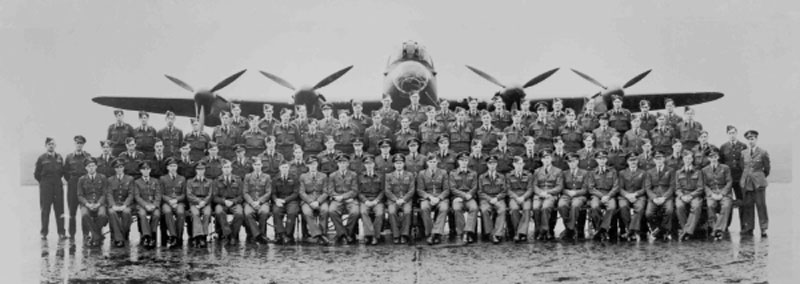
617 Squadron

Date: 10 March 2016

Time: 6.30pm

Cost: FREE

The role of No. 617 Squadron, Royal Air Force, better known as the ‘Dam Busters’ will be the focus of a lecture taking place at the University of Wolverhampton next month. The lecture entitled ‘Planned Development or Haphazard Evolution? No. 617 Squadron, 1943-45′ will be presented by Dr Robert Owen, the Official Historian of the No. 617 Squadron Association. The lecture is a continuation of the joint partnership between the University’s Department of War Studies and the Royal Air Force Museum and takes place on Thursday 10 March 2016.

In this lecture, Dr Robert Owen will discuss the backstory to the units operations during the Second World War and the decision to keep them in existence as a precision-bombing unit. For the remainder of the Second World War, they carried out precision attacks using new and unconventional weapons, culminating with Barnes Wallis’s deep penetration bombs, ‘Tallboy’ and ‘Grand Slam’.

Many of the Squadron’s eventual operations emerged as the result of an inability to execute initial planning due to unrealistic expectations of weapon performance, delays in the development of a new weapons and political intervention. The Squadron played a major role in the assessment of weapons, equipment and new techniques and were often given alternative targets, taking advantage of their capabilities and to address specific issues. During its comparatively short period of active service No. 617 won 2 Victoria Crosses and more than 150 other decorations.

The numerous accounts written detailing the Squadron’s history fail to take into account many of the factors that determined its role and concentrate on the operational record and the weapons used. The result is a distorted and incomplete perception of the Squadron’s development and a misconception of its full contribution to the bomber offensive.

This lecture will identify the various policy and decision making bodies and examine their role in selecting weapons and targets for the Squadron. It will explore the issues which determined the role played by the Squadron, including changes in Air Staff policy for Bomber Command, choice of targets, the development and production of weapons and tactical requirements. Comparison is made between the planners’ original intentions for the Squadron and the final operational record.

The Trenchard Lectures in Air Power Studies form part of the RAF Museum’s Research Programme for 2016. ‘Planned Development or Haphazard Evolution? No.617 Squadron, 1943-45′, is the first of three joint lectures taking place at the University of Wolverhampton this year.

Dr Ross Mahoney, RAF Museum Aviation Historian said:

“The RAF Museum is once again delighted to be working in conjunction with our colleague at the University of Wolverhampton to bring the Trenchard Lectures in Air Power Studies to a wide audience. The year’s first lecture is about one of the RAF’s most famous units, the Dambusters. The lecture will highlight No. 617’s development beyond the famous Dams raids of 1943 and open up a new understanding of the Squadron’s contribution to the Second World War.”

Dr Peter Preston-Hough of the university’s Department of War Studies said:

“We’re delighted to be part of this prestigious series of lectures, which promises to provide an interesting insight into this area of history.”

This FREE lecture will be held in the main lecture theatre (MC001) at the University of Wolverhampton at 6.30pm on Thursday 10 March. As spaces are limited, organisers advise visitors to book their tickets in advance via the museum’s website to avoid disappointment.

For further information about the museums research programme or to book your FREE ticket to the lecture, please visit the museum website www.rafmuseum.org/cosford.

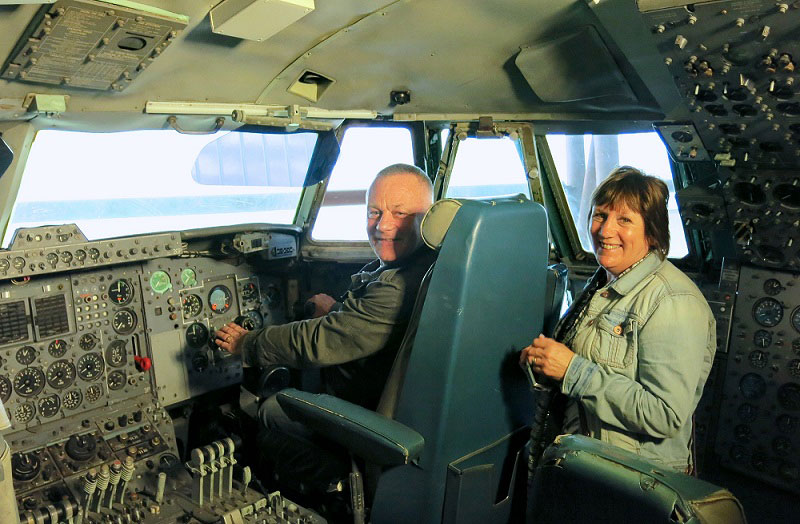
TriStar Simulator Acquired

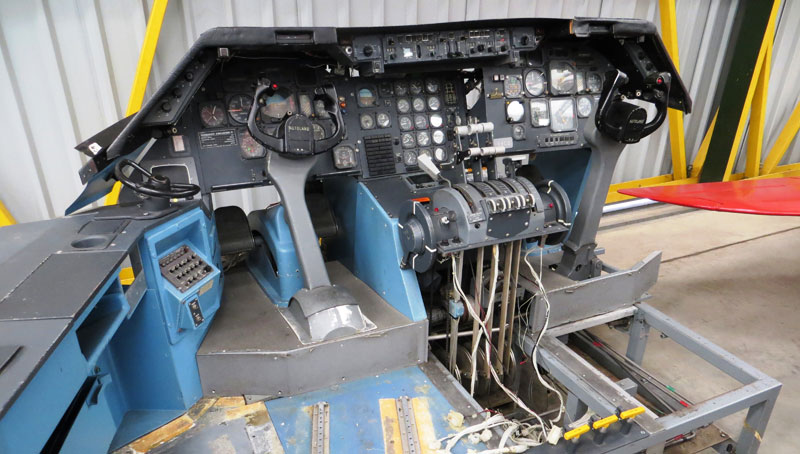
TriStar Simulator Newark Air Museum

During the week commencing 15th February 2016 the Newark Air Museum took delivered of its latest exhibit, a Lockheed TriStar Simulator at its site in eastern Nottinghamshire, close to the border with Lincolnshire.

The museum was first made aware of the possible disposal of this Lockheed TriStar simulator from the Royal Air Force Museum at Hendon, back in autumn 2015. This potential acquisition was to be in the form of a gift. After gathering more details about the simulator, the museum trustees decided to register the museum’s interest in the former crew-training aid.

It was just before Christmas 2015 that Newark Air Museum was notified that, out of several other groups who had registered interest in the simulator, that it had been selected to receive the item.

Initially it had been anticipated that the simulator would arrive in one piece, but this was not the case as the simulator had already been disassembled. An assessment of the move requirements was made and the first of several loads arrived at Newark on Monday 15th February.

The TriStar simulator has been placed into temporary storage in Display Hangar 2 at the museum and is not currently on display. It is understood that the museum’s mainly volunteer workforce will start to reassemble the simulator after the Spring Indoor Aero boot sale event on 5th March.

Various display locations in Display Hangar 2 are currently being evaluated and at this time it is not known to what extent the simulator will be returned to an operational condition. This latest acquisition complements the museum’s growing collection of ‘synthetic’ trainers and adds part of a notable airliner cockpit to the museum collection.

The museum trustees are grateful to the RAF Museum for donating this exhibit to the Newark Air Museum.

www.newarkairmuseum.org

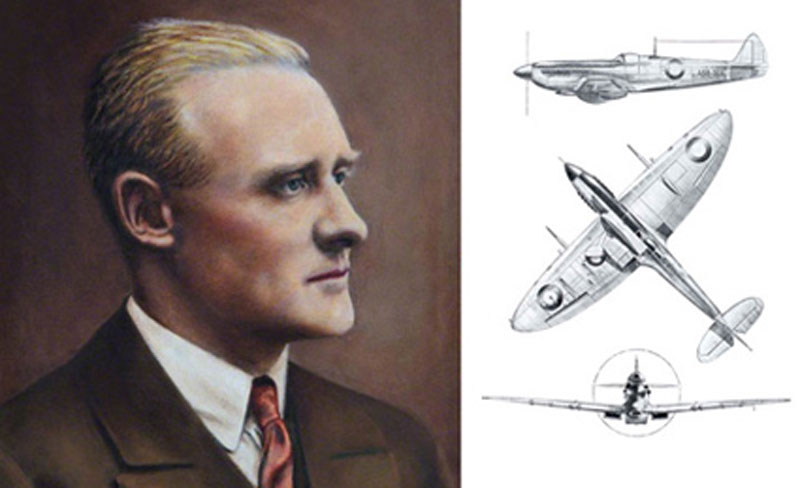
Spitfire legends honoured at 80th anniversary event

R J Mitchell

Date: 5 March 2016

Time: Talk 1 – 11.30am

          Talk 2 – 2.15pm

Cost: FREE

The Supermarine Spitfire, the most famous British fighter aircraft in historyfirst took to the skies on 5 March 1936 and won immortal fame throughout the summer months of 1940 by helping to defeat the German air attacks during the Battle of Britain.The Royal Air Force Museum Cosford will be marking eighty years since the first flight of the Spitfire on Saturday 5 March 2016, with a day of special talks.

The talks will pay tribute to Spitfire creator RJ Mitchell CBE and Vickers Supermarine test pilot Alex Henshaw MBE and the men of the Battle of Britain.

In the first talk entitled ‘R. J. Mitchell CBE, the Spitfire and the Battle of Britain . . .Their Finest Hour’,Tony tells thestory of Staffordshire born R. J. Mitchell CBE, the creator of Britain’s most iconic aircraft and some of the men who flew Spitfires in the Battle of Britain. The Spitfire, an evolution from the Schneider Trophy Races, first flew in 1936, remained in production through the 1940s and in service throughout the 1950s. Hear stories from some of the men who fought the Battle of Britain, including a distinguished Luftwaffe ace in interviews recorded with Tony. The talk will commence at 11.30am lasting approximately one hour.

The second talk of the day entitled ‘Alex Henshaw MBE. . .The Flight of the Mew Gull and Sigh for a Merlin’includes video footage of Alex Henshaw telling his own story. He won the King’s Cup Air Race and achieved a record-breaking solo flight from London to Cape Town and back in four and a half days with just a compass, a chronometer and a set of maps – a record unbeaten for more than 70 years. He served throughout the war as Chief Production Test Pilot for Vickers Supermarine, personally testing more than 2,000 Spitfires and the occasional Lancaster at both Southampton and Castle Bromwich (now the Jaguar factory). He finished his flying career marketing aircraft in South Africa where he flew his last epic flight. During the video footage, Alex recallsmemories of his heroic tales includingflying an aircraft down the centre of Broad Street in Birmingham when asked by the Mayor. The talk will commence at 2.15pm lasting approximately an hour and 15 minutes.

The talks will be presented by Tony Edwards, a friend of Alex Henshaw. Tony has enjoyed a comprehensive career within the aerospace industry, commercially, within the Ministry of Defence and Academia. He is a keen supporter of the Royal Air Force Museum and a former Trustee.

Both talks will take place in the museum’s lecture theatre inside the National Cold War Exhibition and are suitable for all ages.

Don’t forget, thatof the 1,566 Spitfire I’s that were built, the RAF Museum Cosford is home to the world’s oldest surviving example of its type. Especially for this 80th anniversary event, the canopy will be opened and visitors can get an up-close view of the cockpit. The Spitfire is displayed alongside the Hurricane in the Museum’s War in the Air hangar and viewing will be available all day.

The Museum is open daily from 10am and entry is FREE of charge. To book your place on the FREE talks, please visit the Museums website www.rafmuseum.org/cosford.

NEW aircraft added to Open Cockpits Evening line-up

RAF Museum Shorts Belfast

Date: 13-14 May 2016

Time: 6.00pm to 9.00pm

Cost: £12.50 per person

Aviation fans are being given the chance to climb on board a selection of historic aircraft and sit in the pilot’s seat during an ‘Open Cockpits Evening’ event taking place at the Royal Air Force Museum Cosford. The event which runs on Friday 13 and Saturday 14 May will offer 300 visitors each evening the rare opportunity to step inside some of the world’s most iconic aircraft, including two research jets which have never been opened to visitors before.

Visitors can experience what it feels like to sit inside a military aircraft that’s seen action around the world and marvel at the advanced technologies on unique airframes. So whether it’s a fast jet to spark interest in the younger generation, or a nostalgic wartime aircraft that brings back memories with older visitors, with the mix of aircraft available there is something to please everyone.

Confirmed aircraft include the never before opened English Electric P1A. This experimental aircraft was the basis for the RAF’s front line fighter, the English Electric (later BAC) Lightning and was the first and only truly supersonic aircraft developed by Britain on her own. This radical and far sighted design was considered so novel there were concerns as to whether it could succeed. The museum’s example is the first of two prototypes built to test the 60 degree sweepback wing and the low position tail plane, a concept that was later confirmed. The P1A exceeded the speed of sound in level flight, achieving in excess of Mach 2.0 and went on to become the RAF’s front line fighter, staying in service for nearly three decades.

Also new to the event list is the Fairey Delta 2 (FD2), one of only two FD2S ever built. Devised in response to Britain trailing behind in supersonic aircraft design during the late 1940s, the Ministry of Supply issued a specification for a supersonic research aircraft. Fairey set about meeting this with a single-seat, delta-winged aircraft powered by a Rolls-Royce Avon engine with an afterburner and called it the FD2. To improve the pilot’s forward view during landing, taxiing and take-off, the aircraft had a unique feature whereby the cockpit and nose section could be hinged downwards by ten degrees. In March 1956 the FD2 broke the World Air Speed Record reaching speeds of 1132mph, breaking the record by 300mph set by an American F100 Super Sabre the year before.

This May will be the first time Visitors at Cosford have been able to get on board both the P1A and the FD2 and organisers are confident they will be popular with aviation fans wanting a closer inspection. Visitors to ‘Open Cockpits Evening’ can also view inside the cockpit of the British Aircraft Corporation TSR2 – one of the most exciting and controversial British combat aircraft designs of the 1960s. Plus, the giant Short Brothers Belfast, a long-range, strategic RAF transport aircraft weighing over 56 tonnes when empty, will be opened up for visitors along with the Handley Page Hastings and the Mikoyan-Gurevich MiG-15bis to name but a few.

RAF Museum Cosford Event Manager, Abi Betteridge said:

“Events like this make a visit to the museum extra special as it’s such a unique opportunity to have access inside military aircraft. To make sure visitors get the most out of the event, we have a fantastic team of Volunteers on hand to answer any questions they may have. We have also added two new aircraft to the list, along with some that haven’t been open for a number of years, so there is something new and exciting for our repeat visitors.”

‘Open Cockpits Evening’ is part of ‘The Museums at Night’ cultural event, an annual international event where hundreds of museums, galleries, libraries, archives and heritage sites across Europe open their doors to the public for special after hours events. Visitors will have exclusive after-hours access to the museum which displays a collection of over 75 aircraft, military vehicles, engines and aviation artefacts within three wartime hangars and the National Cold War Exhibition.

Tickets are now available to purchase through the museum’s website www.rafmuseum.org/cosford and cost £12.50 per person which includes parking. Minimum height restrictions of 1.07 metres will apply. The Museum will close at 5.00pm both days, however the Visitor Centre and Refuel Restaurant will remain open for visitors attending the evening event which commences at 6.00pm and finishes at 9.00pm.

Tickets for a second Open Cockpits Evening taking place in September which will feature a different collection of aircraft to the May event are also on sale via the Museum website.

Carole Vorderman Open News Exhibition at RAF Museum

RAF Museum Carole Vorderman

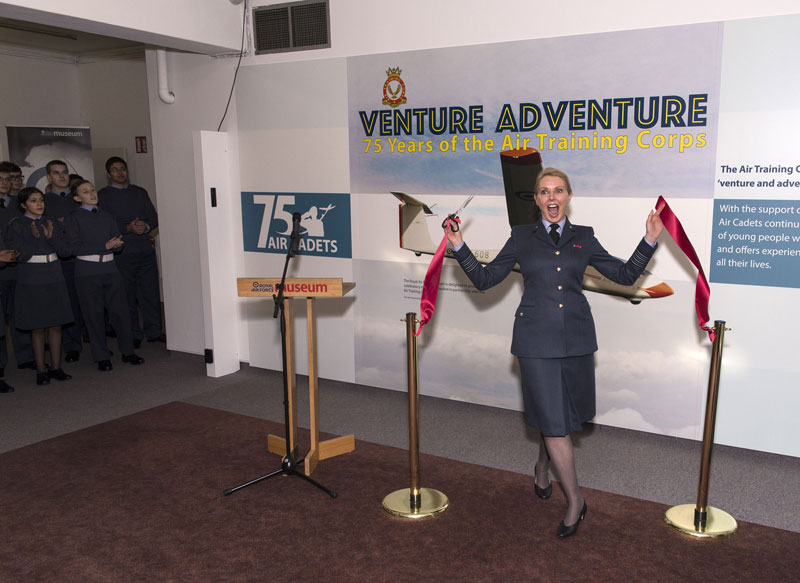
The RAF Museum is pleased to announce the launch of its newest temporary exhibition ‘Venture and Adventure’ which marks the 75th Anniversary of the formation of the RAF Air Cadets*

Air cadet officers have been working closely with the Museum’s team to produce the exhibition which chronicles the exciting story of the Air Training Corps, from 1941 when it was established, right through to the very latest developments.

Together with a range of other anniversary events across the UK to mark the organisation’s 75th year, the exhibition aims intended to raise public awareness of what is one of the finest national voluntary youth organisations in the world.

As honorary ambassador for the Air Cadets, TV personality Carol Voderman was on hand to open the exhibition at an event attended by RAF VIP’s, local cadets from Barnet and the Mayors of Barnet and Harrow.

Project Officer, Flt Lt Roger Starling said: “This fascinating exhibition will be located in the Art Gallery area on the first floor of the museum’s main building and will use specially designed panels to illustrate key cadet activities. There will also be some historic artefacts on display, including an original uniform from 1941.”

A second, smaller exhibition will feature at the museum’s other site at RAF Cosford, Shropshire. Admission to both exhibitions is free and they will run until November 11 next year (2016).

*The RAF Air Cadets comprises both the Air Training Corps and the Combined Cadet Force (RAF).

www.rafmuseum.org

Sea Harrier at Newark Air Museum

Newark Air Museum Sea Harrier

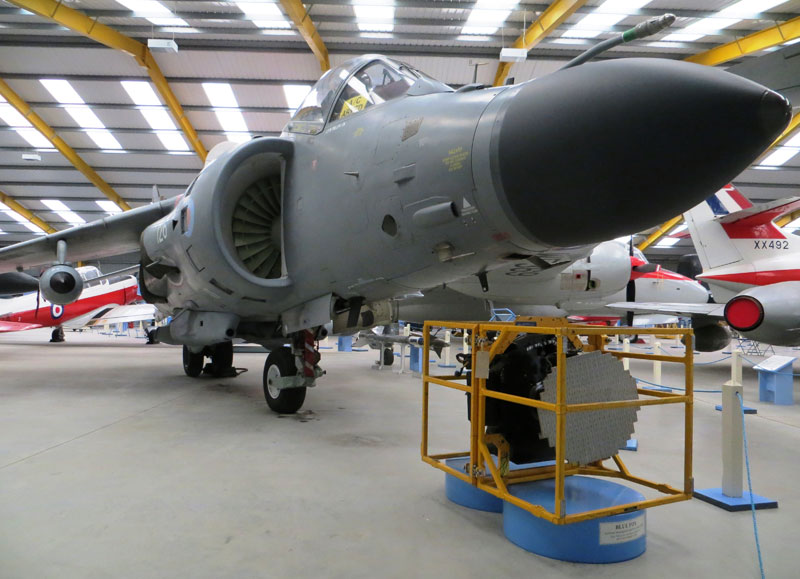
Since the start of 2016 Sea Harrier FA.2, ZA176 at Newark Air Museum has been receiving an ‘armament upgrade’, which has given the airframe more of an operational appearance.

For several years the museum has been acquiring a selection of Sea Harrier compatible weapons fit, which, until now this has been displayed underneath the airframe. A new volunteer has recently joined the museum and he has been using his former skills as an Armourer to assist with fitting the weaponry to the aircraft.

Amongst the first items fitted were a set of CBLS (Carrier Bomb Light Stores) units. In service the CBLS units allows military aircraft to carry up to 4 light stores (or practice bombs) on each weapon station. The use of practice bombs during training helps reduce costs and minimises risks during aircrew weapons training. These units help illustrate the important training aspect of Sea Harrier operations and fits in with the museum’s own themes of flight training.

Two rare, ADEN 30 gun pods have also been fitted to ZA176 to replicate the units carried operationally by the Sea Harriers until they came out of service in 2006. These pods have been refurbished and repainted using a grey paint that has been carefully matched to the airframe colour.

Sea Harrier ZA176 joined the Newark Air Museum collection from RNAS Yeovilton, Somerset, on Wednesday 21st July, 2004. ZA176 helped complete the V-STOL airframe lineage displayed at the museum. This started with the Meteor FR.9 flying test-bed and associated RB.108 vertical lift engine and now moves along to the Sea Harrier, which is complemented by a recently acquired Pegasus engine. ZA176 was also the seventh Fleet Air Arm aircraft to be displayed in the museum collection.

www.newarkairmuseum.org