Open Cockpits tickets on sale 24th February

OPen Cockpit evening RAF Cosford

Open Cockpits Evening – 10th May 2014

6.00pm to 9.00pm

£12.50 per person

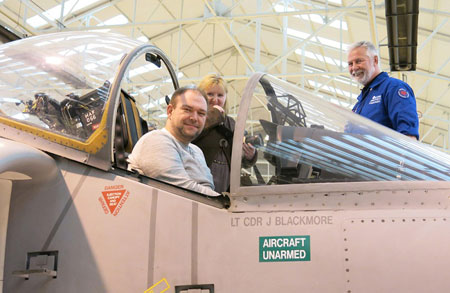
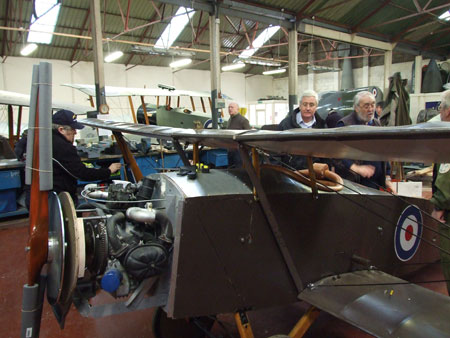
Tickets for the popular aviation enthusiasts’ event ‘Open Cockpits Evening’ at the Royal Air Force Museum Cosford, will go on sale from Monday 24th February through the Royal Air Force Museum’s website. Just 300 tickets will be available for this exclusive evening on Saturday 10th May, where a wide range of aircraft will be available for close viewing on the night: including transport aircraft, jet fighters and unique research airframes.

300 fortunate visitors will be able to get a feel for what it was like to fly these much loved machines by entering their cockpits and, in addition to this, will have exclusive after-hours access to the Museum which displays a collection of over 70 aircraft, military vehicles, engines and aviation artefacts within three wartime hangars and the award-winning National Cold War Exhibition.

The event, which is held twice a year in May and September, was a complete sell out in 2013 and 2012, with tickets sold out in a matter of days. Organisers are confident that this year’s event in May will be just as popular based on the number of enquiries received so far. Accordingly, the Museum is advising aviation fans to book early to avoid disappointment.

The evening will commence at 6.00pm and finish at 9.00pm, with numbers onto the Museum site strictly limited to 300 people – providing enthusiasts with three hours to examine the Museum’s historic and wondrous aircraft in an exclusive environment. Admission is by advance ticket only; tickets cost £12.50 per person and will go on sale from Monday 24th February available through the Museum’s website. Members price £10.00 per ticket (please note membership cards will need to be shown on entry to the event). Parking charges are included in the ticket price. Minimum height restrictions of 1.07 metres will apply.

The Museum will close at 5.00pm on Saturday 10th May in order to set up for the Open Cockpits Evening event. A detailed list of aircraft open on the night will be issued nearer the time. For further information on the ‘Open Cockpits Evening’ or to purchase your tickets online visit www.rafmuseum.org, a second Open Cockpits Evening will take place on Saturday 20th September 2014.

Wanted: Elbow Grease for the Dornier 17

On 10th June 2013 the Royal Air Force Museum created history when it successfully raised the last remaining Dornier Do 17 German Bomber from the bottom of the Dover Straits.

On 28th of February 2014 the Royal Air Force Museum in London will be unveiling a brand new display dedicated to the Dornier Do 17 project in the Museum’s Sunderland Hall, in association with Wargaming.net.

As part of the display the Museum will be unveiling recently conserved artifacts from the aircraft never seen by the public before: and will be showing film footage and photography that tells the story of this fascinating project from its initial planning, to the gripping successful lift, and the aircraft’s arrival at Cosford for its conservation.

The unveiling is open to everyone. It will commence at 11 o’clock and members of the public are encouraged to meet with members of the Michael Beetham Conservation Centre and those of the Museum’s Apprentices who have worked on the Dornier Do17’s conservation. Also on hand will be the experts from Imperial College London who devised the conservation process plus members of Museum Team who planned and executed the actual lift. All of whom will be happy to answer any questions that people may have about the Dornier Do17 project.

As part of the day’s activities visitors to our London site will have for one day only the never to be repeated opportunity to clean parts from the retrieved aircraft under the careful guidance of the Museum’s Conservation Team. Conservation and Q&A sessions with our experts will run from 11am to 1pm and from 2pm to 4pm on the day.

Those members of the public wishing to get even more out of their day, can do so by downloading the Museum’s Dornier Do17 app now available for Android and i-Phone before visiting. This will enable them, on arrival, to view the Dornier Do17 in mid-flight over the Museum and to walk, courtesy of augmented reality, underneath this historic aircraft whilst viewing it through their smart-phones.

Ian Thirsk, Head of Collections, at the Museum said :

‘ I would urge anyone in London and the South East who has followed the Dornier Project to date to attend this event. This day is your chance to ask the questions that you want answered by the Project’s Team. The Museum has been, over the last 12 months, overwhelmed by the support that it has received from the public in London and the South East throughout the Dornier Do 17’s recovery and conservation. This unveiling is our way of saying thanks to those of our supporters from the region by giving them the unprecedented and never to be repeated opportunity to participate in the conservation process by cleaning some of the smaller objects which have been recovered from the aircraft, under the careful guidance of the Conservation Team.’

Admission to the unveiling ceremony and to the Royal Air Force Museum is free of charge. The opportunity to work on parts of the Dornier Do17 is on a strictly first come, first served basis. The total amount of time that each visitor will be allowed to work on a part will be restricted to 10 minutes each. To participate is this element of the unveiling visitors must be aged 15 and over. Museum Staff reserve the right to refuse requests to work on Dornier Do17 parts on the day. For further details about this event please go to www.rafmuseum.org/whatson.

Unique Mustang model now on display

Mustang Scale Model

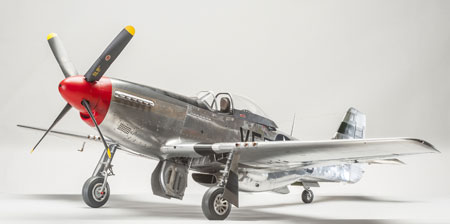
Now on display at the Royal Air Force Museum Cosford is a 1:5 scale scratch built North American P-51D Mustang. This unique model took almost ten years to build and was kindly donated to the Museum in autumn last year. This remarkable Mustang model now forms a centre piece display in the Museum’s Visitor Centre where visitors can view all its intricate details up close.

The model is the work of retired journalist and avid modeller David Glen and was built in tribute to the US pilots and crews who gave their lives in support of their European allies over two World Wars. At over 6ft in length with a wing span of over 7ft the model bears the markings of VF-B 413317, the aircraft flown by Captain Donald R. Emerson, 336 Squadron, 4th Fighter Group who was killed on Christmas Day 1944 during the Battle of the Bulge.

During the planning stages, scale measurements and other data were taken from a variety of sources, among them the Smithsonian archive in Washington DC. David’s references include all the P-51D handbooks and manuals and the entire set of North American production drawings, from which all the detail parts were built. The model went through several processes during the building stage and was constructed from plywood profiles and sections, in-filled with solid balsa providing a rigid and stable wooden core, over which the litho skin was formed and glued. Every rivet was placed individually into holes drilled through the skin and all the visible screws, bolts and nuts were replicated using real brass or steel fastenings.

Building such an intricate model from scratch came with its own difficulties. Working with rivets of 1/6 inch in size using tweezers and a tiny dab of glue was a tricky and time consuming process. Manufacturing numerous resin parts including tiny instrument bezels, airscrew blades and wingtips each had their own individual challenges, but none as challenging as building the cockpit canopy. This complex model is an engineering marvel and the attention to detail even includes data plates, complete with all the original logos and lettering, many of the plates are smaller than a £1 coin.

This is the second model David Glen has donated to the RAF Museum. His first donation of a similarly scaled Spitfire Mk.1 is on display at the RAF Museum London, where the real North American P-51D Mustang can be seen on display.

David Glen, Modeller said:

“As far as I can make it, the model is complete and accurate in every visible detail, right down to the electrical wiring. It occupied my spare time for the better part of a decade, so I am especially proud to see it join my Spitfire on public display at the Royal Air Force Museum. I cannot conceive of a better home, and I hope that both models might stand as my own small tribute to the allied pilots and crews who gave their lives over two World Wars.”

Anyone wishing to take a look at this unique model, the P-51D Mustang is now on permanent display, located in the Museums’ Visitor Centre. The Museum is open daily from 10am and admission is free of charge. For more information on the 1:5 scale Mustang Model please visit David Glen’s website www.spitfireinmyworkshop.net

For more information on the Museum, visit www.rafmuseum.org or call 01902 376200

IWM Duxford stars in Hollywood film The Monuments Men

Monuments Men

Hollywood film The Monuments Men, which was partly filmed on location at IWM Duxford, opens to UK audiences on Friday 14 February.

Director George Clooney is joined on screen by an internationally acclaimed ensemble cast, many of whom were at IWM Duxford for the filming, including Matt Damon (Ocean’s Eleven, The Bourne Identity), Cate Blanchett (The Lord of the Rings, Elizabeth), Bill Murray (Lost in Translation, Ghostbusters), John Goodman (Argo, The Big Lebowski), Jean Dujardin (The Artist) and Hugh Bonneville (Downton Abbey).

Filming at IWM Duxford was a large-scale operation, involving not only the leading actors, but also over 300 extras, over a nine day period. Filming took place across the museum, including the North Side of the site, which is not open to the public, but houses IWM’s collections within historic buildings that made up the domestic side of the RAF fighter station.

Second World War aircraft and vehicles were brought to the museum to act as props and set dressing for the scenes. IWM Duxford’s historic buildings, control tower and airfield significantly featured in the filming.

The Monuments Men opens in the UK on Friday 14 February.

View the film trailer at http://www.youtube.com/watch?v=czYqP1jbPTk

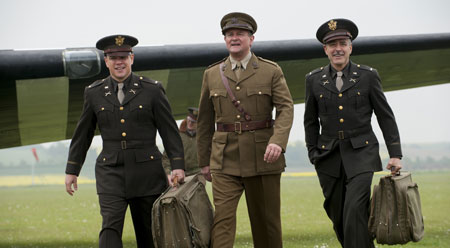
Photo credit: left to right, Matt Damon, Hugh Bonneville and George Clooney on set at IWM Duxford. Photograph courtesy of Twentieth Century Fox.

www.iwm.org.uk

Model Show at the Fleet Air Arm Museum

The Fleet Air Arm Museum’s February Model Show has attracted quite a following. In addition to exhibitors travelling from London and the Home Counties, Cornwall and Wales, the event has also attracted two intrepid exhibitors from Scotland. David Jack and Dougie Salmon represent Edinburgh Model Boat Club and travel from Edinburgh with their display of WW2 warships.

Says David Jack “I attend shows all over the country but this one is the biggest and best and the natives are quite friendly”.

The show attracts model makers of all persuasion – Over 110 traders and clubs will be exhibiting radio controlled and plastic aeroplanes, tanks, ships figures and more.

Says event organiser Jon Jefferies “The event has been running for eighteen years and has attracted a loyal following of enthusiasts”.

The highlight of the show will be a flying display by the British Model Flying Association whose model making and piloting skills are admired around the world. The flying line-up for this year has yet to be confirmed but previous shows have seen a 20ft wingspan B52 bomber and jet powered model Concorde taking to the skies.

Whether your interest is in kits or ‘scratch built’ model aircraft the Fleet Air Arm Museum’s Feb Model Show undoubtedly will have something for everyone.

There will be competitions for plastic modellers with generous prizes sponsored by Airfix, so bring along your best models and you could walk away with a prize.

Standard museum entry prices apply and there is no additional fee for the Model Show. In addition to the show, visitors can have the opportunity of going on board the first British Concorde and on the award winning aircraft carrier experience.

Doors open at 10.00am. Normal admission prices apply and there’s no extra cost for attending the show. Tickets can be bought in advance on the Museum’s website www.fleetairarm.com

Take a Walk in the Skies Over Britain

Aerofilms - Britain from Above exhibition

The RAF Museum and English Heritage invite you to discover a brand new exhibition with the most breathtaking views.

Exhibition: Aerofilms: Britain from Above

Date: 20th: February 2014 to 1st March 2015

Entrance: FREE

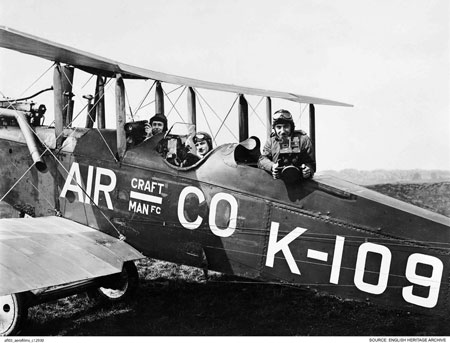
In 1919, in the area where the RAF Museum now stands in Hendon, North London, the world’s first firm of commercial aerial photographers – Aerofilms – was established.

Aerofilms was founded by two pioneers who married the fledgling technology of flight with the discipline of photography- Claude Grahame-White and Francis Lewis Wills

For the next 80 years Aerofilms captured Britain’s villages, towns, cities and landmarks from the air which provided unique and stunning views of the development of Britain’s rural and urban landscape throughout the 20th century.

At the outset of World War II the company was requisitioned by the Air Ministry, with its aerial interpretation skills making an invaluable contribution to the war effort as part of the highly successful Central Interpretation Unit at RAF Medmenham in Buckinghamshire. Iconic aircraft such as the Spitfire – featured in this exhibition – proved invaluable for this purpose. After the war, Aerofilms once again took to the skies, photographing the rapidly changing face of Britain’s urban centres and rural landscapes.

The Aerofilms Collection was acquired for the nation in 2007 by English Heritage and its partners the Royal Commission on the Ancient and Historical Monuments of Wales and Scotland – over 1 million oblique aerial images of Britain were acquired. In 2010 funding was secured from the Heritage Lottery Fund and the Foyle Foundation to help conserve, digitise, catalogue and make accessible the earliest part of the Aerofilms collection under the banner of Britain from Above. The Britain from Above project has ensured that this unique and enthralling picture of Britain in the 20th century has been saved and made accessible to the public for the first time. Over 95,000 images dating from 1919 to 1953 are available to explore online at the project’s dedicated, interactive website www.britainfromabove.org.uk 

The Exhibition:

The completion of the Britain from Above project will be celebrated this year with a series of exhibitions across England, Wales and Scotland. The RAF Museum is host to the first English exhibition, jointly curated with English Heritage. Members of the public can trace the history of this landmark company and see the changing face of Britain in the 20th century through Aerofilms’ unique aerial archive.

As well as the images, the exhibition also includes aerial cameras, a Spitfire and Aerofilms’ own A5 Autograph machine. This machine – the first ever to be brought to England – was imported by Aerofilms in 1938. The A5 Autograph is an instrument designed and built by the Swiss firm Wild (pronounced “Vilt”) to take accurate measurements from photographs in order to produce maps. Aerofilms’ use of the A5 during World War II was revolutionary. The machine’s excellent magnification and measurement accuracy meant that it was possible to make valuable interpretations from small-scale images that otherwise were useless to the Air Ministry.

English Heritage, in association with the Royal Commissions on the Ancient and Historic Monuments of Wales and Scotland, has published a book to accompany the exhibition: Aerofilms: A History of Britain From Above by James Crawford, Katy Whitaker and Allan Williams.

As well as including 200 fascinating images from the Aerofilms collection – many of which are previously unpublished – the book allows plenty of space to tell the compelling human stories behind the Aerofilms company, at the same time providing an authoritative record of rapid social, industrial and architectural changes in Britain in the first half of the twentieth century.

ISBN: 978-1-84802-248-5

RRP: £25.00

Hardback, 224pp, 245x300mm

Andy Renwick, Curator of Photographs, RAF Museum

“It is wonderful to be working with English Heritage on this exhibition. The RAF Museum is the perfect setting for this exhibition as like us, Aerofilms was established on the site of the London Aerodrome. Our shared history also extends to our collection – with the Spitfire being one of the most successful aircraft for photo- reconnaissance.”

Mike Evans, Head of Archive at English Heritage

“I am delighted that we are able to bring this nationally important collection back to Hendon where the firm was founded in 1919. The Aerofilms Collection embodies all that is exciting about aerial photography. Between 1919 and 1953, there was vast and rapid change to the social, architectural and industrial fabric of Britain, and Aerofilms provides a unique and at times unparalleled perspective on this upheaval. We hope that people today will be able to immerse themselves in the past through the Britain from Above website, adding their own thoughts and memories to this remarkable collection.”

Britain from above will open on 20th February and is available for viewing Monday to Sunday between 1000am – 6.00pm with free admission to all.

www.rafmuseum.org

Canberra PR9 to display at Abingdon Air & Country Show

The iconic and celebrated Canberra XH134, the world’s only airworthy PR9, will join an array of aviation acts, including the Breitling Wingwalkers, Trig Team and a P40 Kittyhawk, at the Abingdon Air & Country Show on Sunday 4th May.

In her first scheduled airshow of the year, XH134 will perform a revised display, showcasing the exceptional PR9 capabilities, under the skilled piloting of Sqn Ldr Dave Piper and Flt Lt Mike Leckey. Incorporating a variety of impressive manoeuvres, visitors will be captivated by the power and noise of XH134.

Designed as the RAF’s first jet bomber, the Canberra had an exceptional career spanning 55 years of active service, before retiring from operations in July 2006. Following an extensive restoration by C2 Aviation, XH134 unveiled the striking new silver colour scheme of the Midair Squadron in September 2013, and will be flanked by two Hawker Hunters as the 2014 season progresses.

Aircraft owner, Michael Davis, explains, “The refined PR9 display showcases XH134 in all her glory. Demonstrating the sheer power and capabilities of the photo reconnaissance aircraft, it is a pleasure to introduce XH134 back to the display circuit.”

Speaking of the new air display, Sqn Ldr Dave Piper comments, “It is an honour to fly such an internationally recognised aircraft, in front of crowds who have supported her restoration from the outset.”

The annual Abingdon Air & Country show, located at Abingdon Airfield, is staged to raise money for the Thames Valley & Chiltern Air Ambulance Trust, donating over £45,000 since 2007. Over 9,000 visitors are expected this year.

www.abingdonfayre.com

Swiss Turn Airshow Into Joint Celebration

Patrouille Suisse

The Swiss Air Force has ensured the Red Arrows won’t be the only aerobatic display team celebrating an aviation landmark at this summer’s Royal International Air Tattoo at RAF Fairford on July 11-13.

It has announced plans to send their aerobatic display team, the Patrouille Suisse, in their 50th anniversary year, along with an F-18 Hornet and Super Puma helicopter to take part in the Air Tattoo’s flying display.

Air Tattoo organiserssaid that official celebrations markingthe 50th display season of the Red Arrows would also include the Patrouille Suisse in order that their anniversary was also recognised.

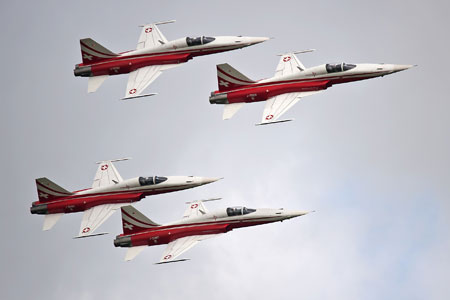
Formed in 1964, the team fly six F-5E Tiger IIs painted in a bright colour scheme that incorporates the red and white of the Swiss national flag. The pilots, who are all volunteers from various frontline squadrons, are famed worldwide for performing precise formations at high speed.

Air Tattoo spokesman Richard Arquati said that as an international celebration of aviation,it was important thatthe Air Tattoo recognised important anniversaries being celebrated by other participatingair arms.

He said: “The Swiss have particular cause to celebrate this year. Not only is it the 50th anniversary of the Patrouille Suissebut it is also the 25th anniversary of their PC-7 aerobatic display team. On top of that, the Swiss Air Force will also be marking the 100th anniversary of military aviation in their country. Given all these anniversaries, we’re really pleased that the Swiss have agreed to support our airshow in such an incredible way.”

The Swiss Air Force have been regular visitors to the Air Tattoo since first attending the airshow at RAF Greenham Common in 1979 with the Patrouille Suisse. Then, the team flew six Hawker Hunter F-58s before switching to their current Northrop F-5E Tiger II jets in 1995. Accompanying the display team on their first visit was a Swiss Air Force de Havilland Venom FB.4, which was presented as a gift, to the Royal Air Force Museum.

This summer could be one of the last times the Patrouille Suisse perform in the UK after it was announced last year that the team would be disbanded in 2016 due to the withdrawal of the F-5 from Swiss Air Force service.

Specially-priced Super Earlybird tickets for next summer’s Air Tattoo, on July 11-13, are available until the end of January from www.airtattoo.com or by calling 0800 107 1940. All accompanied under-16s go free. Free parking.

Interesting Restoration Project at Yorkshire Air Museum

Eastchurch Kitten Yorkshire Air Museum

One of the aircraft restoration projects currently in progress at the Yorkshire Air Museum is indeed something of a rarity! It is the construction from a very faded and sketchy print of plans of a hardly known WWI fighter, the Eastchurch Kitten, of which only 3 prototype examples were built. The aircraft would almost have disappeared from history had not an attempt been made in the early 1980’s to essentially build one from scratch. However, this effort stalled and what existed in the shape of a incomplete fuselage, came to the Museum in 1987. It has lain in store, awaiting its turn, in a long line of aircraft restoration projects until Spring 2011, when the green light was given to the Museum Aircraft Engineering team commence the re-build.

The concept behind the Eastchurch Kitten was by the Admiralty for a ‘high altitude’ fighter to tackle the threat posed by the Zeppelin airships which had brought the war to our shores with bombing raids in 1915. The Kitten was planned to be launched from platforms on battleships, cruisers or even torpedo boats. It was to be a ‘disposable’, one operation aircraft, to simply go up, intercept and shoot down the airship, then ditch in the sea. In 1917, the Royal Naval Air Service Experimental Construction Depot at Port Victoria produced two concepts, the P.V. 7 ‘Grain’ Kitten and the P.V.8 ‘Eastchurch’ Kitten. The latter proved to be the better and made its first flight on 1st September 1917, but was found to be unstable, leading to redesign of the horizontal tail surfaces, elevator and tailplane.

The alterations made the P.V.8 a pleasant aeroplane to fly and it performed better than the P.V.7. However, the 35 h.p Gnat engine was unreliable and the aircraft would have benefited from a more powerful engine and might have been a practical anti-airship weapon. But by this time the threat of the airships had receded and the project was deemed unviable. There was interest in the project in the USA from the aircraft designer James Martin and the P.V.8 was packed for shipping in March 1918 and that’s where the story ends, for it was not known if it ever made the journey or what became of it.

The story of the aircraft and its restoration is now very significant, encapsulating this fascinating piece of aviation history. The project received a major boost during the summer of 2012, when two young French aviation design students undertaking a placement here at the Museum, were able to assist the project leader Ray McElwain, and made many of the wing struts and other parts, such as cable brackets, putting their metal working skills to the test. Since then, the framework has been covered in Irish linen, tautened with dope to a tension similar to a drum and painted in the original specification for a Royal Naval Air Service craft. In addition we have sourced a similar twin cylinder air cooled engine and refitted all the controls so that this 97 year old design is once again live.

Although non-flying the aircraft will be completed for live “ground running” in time for the WWI centenary commemorations alongside the Museum’s other WWl fighters, which include the 1914 BE2 and the 1917 SE5a which is also a live ground running aircraft. The first planned running of the Kitten will be on Sunday 6th April, during the first of our 2014 “Thunder Day” engine running shows. It is also planned for the Kitten and BE2 to be exhibited in the centre of Leeds to herald the regions WWI Centenary Commemorations.

www.yorkshireairmuseum.org

Kestrel goes on display at Cosford

RAF Museum Cosford Kestrel

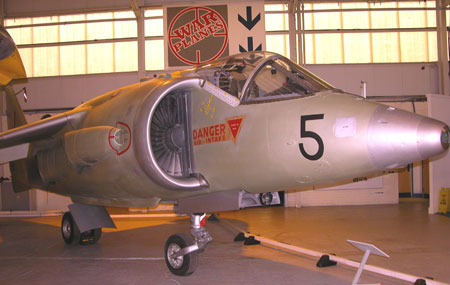
The New Year has got off to a flying start at the Royal Air Force Museum Cosford with the addition of the Hawker-Siddeley Kestrel FGA.1 going on public display. This jet aircraft was built to evaluate the jump jet concept during the 1960s and visitors are now able to view it within the Museum’s Test Flight collection.

The Kestrel, serial number XS695, is one of only nine built by Hawker-Siddeley and its main role was to evaluate vertical take-off in near service conditions. Fitted with a single Bristol Siddeley Pegasus engine and single seat cockpit, the success of the Kestrel came little more than a year before its successor, the Harrier, made its first flight. The Harrier served successfully with the Royal Air Force until 2011.

During the 1950s, Hawker had been privately developing a vertical take-off aircraft under the code of P.1127. The success of this private venture, and the subsequent service interest, led to an announcement in 1962 that a ‘Tripartite Evaluation Squadron’ (TES), also known as the Kestrel Squadron would be formed. The Kestrel was a developed version of the P.1127 and nine of the type were ordered for use by the TES during its operations in 1965. The TES was based at RAF West Raynham and included pilots and ground crew from the UK, USA and West Germany. They used nearby abandoned airfields for testing the aircraft on semi-prepared runways and on grass to test its capabilities on unprepared sites.

The Kestrel made its maiden flight in February 1965 at Dunsfold. By November that same year XS695 had flown 153 times totalling 70.44 airframe hours of which 51.04 were on trials work including 141 sorties with the TES. During 1966 the aircraft was assessed for its handling characteristics, used for training and even appeared at the Hanover and Farnborough Air Shows. In 1972 it was allocated to the Royal Navy Engineering College at Manadon, Devon and later used for apprentice training and to simulate aircraft handling and flight deck procedures.

After being transported by road to the RAF Museum Cosford in November 2001, the Kestrel remained in storage until late Autumn 2012 when it was moved into the Museum’s award winning Michael Beetham Conservation Centre. After undergoing a full restoration and repaint in its tripartite colours which include tri national roundels and fin flashes, the aircraft has now been placed on display for Museum visitors to enjoy.

Nick Sturgess, Alex Henshaw Curator at RAF Museum Cosford said:

“We are delighted to finally have the Kestrel out on public display after its time in storage and its extensive restoration. This aircraft is the only surviving example in the UK and represents an important stage in aircraft development. It was used by three nations to evaluate the jump jet concept and wore a unique colour scheme which can now be seen for the first time since 1965. The results from the Kestrel Squadron would be a huge influence in the development of the Harrier. It now sits alongside the Hunting H126 which was also used to experiment with short take off ideas at the same time.”

The Museum is open daily from 10am and admission is free of charge. For more information on the Museum, visit www.rafmuseum.org or call 01902 376200.