Museum Seeks Blogger In Residence for First World War In The Air Exhibition

The Royal Air Force Museum London is opening its doors to welcome in a blogger in residence as it gears up to the opening of its first major exhibition in over 10 years.

First World War In The Air is a brand new permanent exhibition opening in December 2014 in the museum’s historic Grahame-White Factory: this Grade II listed building was an active aircraft factory during the First World War. The Museum site in North London has a rich history and played an important role in the early development of British aviation. English aviation pioneer Claude Grahame-White described the area as ‘the birthplace of aerial power.’

The exhibition, supported by the HLF will explore what it was like to be involved in the earliest days of military aviation through the story of Britain’s air services, the Royal Flying Corps and Royal Naval Air Service. These two organisations merged on 1 April 1918 to become the world’s first independent air force, the Royal Air Force. This story will incorporate the experiences of pilots, ground crews and factory workers as well as the local North London community.

The lucky blogger will be invited to visit the Museum across key dates* including the VIP opening. They will have full access to the team behind the exhibition and take a behind the scenes look at the exhibition development, installation, aircraft suspension and exhibition build.

Bloggers interested in being considered need to follow @rafmuseum and Tweet us telling us what your favourite thing about the Museum is using #FWWIA and a link to their current blogs by Friday 17th October.

www.rafmuseum.org

First World War Camel takes its place

GWF Camel

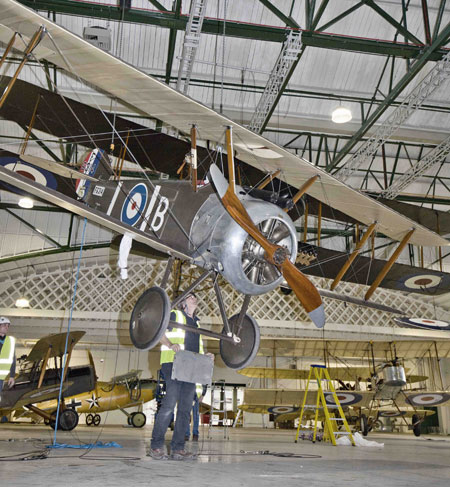
The RAF Museum is pleased to announce the Sopwith Camel is now in position, suspended from the ceiling of the Grahame White Factory. The aircraft will be a key exhibit within the First World War in The Air Exhibition

First World War in the Air is opening December 2014 with support from the Heritage Lottery Fund (HLF).This major new exhibition, will allow museum audiences to discover and explore the unique and often overlooked role of air power during the First World War through the incredible stories of the men and women who took part.

The creation of new exhibitions and supporting activities will be delivered across the museum’s two public sites and online. It will include programmes for lifelong learning, volunteering, apprenticeships and public events. The four-year project will mark the Centenary of the First World War, exploring the development of air power as an integral part of modern warfare and end by celebrating the birth of the RAF in 2018.

www.rafmuseum.org

Dornier Do 17 moves into next stage of conservation

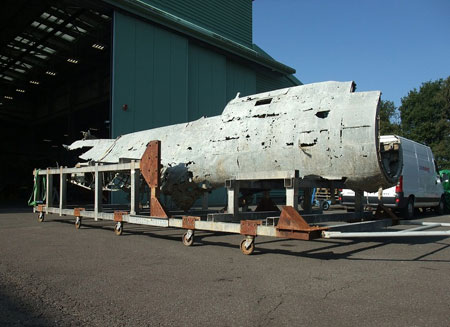
Dornier Fuselage

The world’s last surviving Dornier Do 17 has now moved into the second phase of its conservation at the Royal Air Force Museum Cosford.

It’s been a little over 15 months since the aircraft was lifted from the bottom of the Dover Straits and transported to the Museum’s Cosford site for ground breaking conservation work. The process so far has seen the aircraft systematically sprayed with a low concentration citric acid based solution inside purpose built hydration tunnels. This process has helped to remove marine accretions and subsequently the neutralised corrosion impurities in the aluminium aircraft structure.

The project is progressing at a much faster rate than previously anticipated and the Museum is delighted to see second stage conservation work commence on the aircraft’s forward fuselage. Confident that the citric acid solution has done its job, the fuselage was removed from the tunnels early September and has undergone an intense wash down, before being moved into the Conservation Centre.

Aircraft Technician Andy Woods is now working on the Dornier full time, with his initial efforts focused on internal cleaning and removing any remaining marine deposits with the use of plastic scrapers. Control rods and other smaller items are being carefully removed allowing Technicians greater access to the airframe structure beneath. A team of Volunteers will work on the components removed from the aircraft and which will be put back at a later date.

The construction of the wings has made the process of removing salt and sand from internal sections much slower than the fuselage. The wing section has recently been subject to a deep clean by a team of Apprentices and over a tonne of salt and sand has been removed from the aircraft. Further time in the hydration tunnels is required to allow the citric acid to do its work before the wings join the fuselage in the Conservation Centre.

Both engines and propellers have been removed from the tunnels and mounted on purpose built stands allowing easier access for Technicians to begin treatment. During the aircrafts time underwater the magnesium components disintegrated but the steel components remained fully intact. The majority of the marine deposits have now been removed and a test section has been coated in a 2-pac polly acrylic mix. The Conservation team at Cosford are confident that leaving some of the internal marine deposit on the airframe will provide strength to the fragile aluminium skins.

The Imperial College London continues to offer guidance and over the Summer, Scientist Yanika Agius spent three weeks working with the Museum. Sample testing was carried out on sections of the aircraft to monitor if the spraying process had removed all the crystallised salts from the metalwork. The results showed that most areas were clear with just a few sections of the tail plane needing further attention. Treatment will now see pieces of felt soaked in the citric acid solution and placed on the areas with crystals remaining, concentrating the solution to where it’s needed. Testing will be carried out in a few weeks’ time to see if the remaining crystals have been removed.

The gradual process of removing the thick layer of marine deposits has revealed several bullet holes and shrapnel damage on the airframe, plus small areas of the original paint finish. While working on some of the smaller components, Volunteers discovered push rods still coated in their original oil and when a pipe was removed from a fuel injection unit, a small amount of the original fuel was still present. An interesting discovery during the Summer was the flare pistol still mounted in its original stowage within the forward fuselage. Having informed and called in the appropriate authorities, the pistol was declared safe and Technicians subsequently removed it from the aircraft. Volunteers have since carried out conservation work on the flare pistol which is now on display at the Museum.

Darren Priday, Conservation Centre Manager at RAF Museum Cosford says:

“The citric acid solution has worked wonders on the large and small objects inside the hydration tunnels. It was a major milestone when the forward fuselage was removed from the treatment area and gave us the first indication that there was light at the end of the tunnel. We are not taking things for granted and we are keeping a careful eye on the section as she is quite fragile, but then anything would be after spending 73 years in the hostile Dover Straits.

Having Yanika from the Imperial College was a major boost for us as she was able to carry out tests for salt crystals, something that is not visible with the naked eye. The Cosford volunteers are continuing to carry out the small item conservation and will be available for those attending the Conservation Centre Open Week to learn more.”

At the time of the Dornier’s recovery, it was unclear just how much of the aircraft could be saved following over seventy years on the seabed. Visitors to the Museum are invited to attend the Conservation Centre Open Week in November and see for themselves the fantastic progress being made on the aircraft, only a year and a half since it was raised from the Dover Straits.

The Open Week will run from 9-15 November from 10:15am until 1:00pm each day. Visitors can get up close to the aircraft and speak with the team of Technicians, Apprentices and Volunteers working on the Dornier project as well as other aircraft currently being restored. Admission to the Conservation Centre Open Week is £5 per person with all proceeds going towards the maintenance and upkeep of the exhibits. Children under 16 accompanied by an adult are free.

Admission to the Museum is FREE of charge. Anyone wishing to donate towards the conservation of the aircraft can do so online via the Museum website www.rafmuseum.org. For more information please call the Museum on 01902 376200.

Dominie finally acquired for Newark Air Museum

Newark Air Musuem Dominie delivery

After a short set of negotiations the Newark Air Museum has completed the purchase of Hawker Siddeley Dominie T1 XS726 from Everett Aero of Sproughton, Suffolk. Funding for the acquisition has been provided thanks to the generosity of two long-standing museum members, Mike and Kathy Smith.

On Wednesday 24th September 2014 the airframe was delivered to the museum’s site in eastern Nottinghamshire, which is close to the border with Lincolnshire by a team from Everett Aero. As part of the purchase agreement the wings were refitted to the aircraft by the Everett Aero personnel.

The Dominie fills an important gap in the museum’s themed display of training aircraft. The type was used to teach the skills of systems management, air leadership, decision making and teamwork to various aircrew members including: weapon systems officers and operators, air engineers and air loadmasters.

Dominie’s were retired from RAF service in early 2011 and at that time the museum was unsuccessful in an attempt to purchase one of the airframes that had been operating from nearby RAF Cranwell. The acquisition of Dominie T1 XS726 fulfils this aim and is in line with one aim of the museum’s stated Collecting Policy of acquiring:

“Aircraft used in a Training role.”

The airframe retains its original configuration and is essentially complete. Once reassembled by the museum staff and volunteers XS726 will eventually be moved inside Hangar 2 at the museum. Here it will be displayed alongside several other training airframes, like the Varsity, Jetstream, Bulldog, Gnat and Jet Provost. XS726 is expected to retain its current training scheme markings.

Dominie T1 XS726 was delivered to the RAF on 25th October 1965 and served at RAF Cranwell and with both 3 and 6FTS. Its final training role was as an instructional airframe (9273M) at RAF Cosford and it was delivered there on 24 June 1997. XS726 was moved to Sproughton in 2007.

www.newarkairmuseum.org

Pilots of the Caribbean

african heritage in the RAF

Volunteers of African Heritage in the RAF

Exhibition start date: 6 October 2014

A brand new exhibition entitled ‘Pilots of the Caribbean: Volunteers of African Heritage in the Royal Air Force’ is due to open at the Royal Air Force Museum Cosford next Month. The exhibition opening will coincide with Black History Month, a national event celebrating the achievements of black men and women throughout history.

Curated in partnership with the Black Cultural Archives, the exhibition will tell the inspirational story of these volunteers, commemorating and celebrating their vital contribution to the defence of Britain, her Empire and Commonwealth. Accompanying video footage and artefacts will bring to life the stories of these brave volunteers.

With the outbreak of the First World War, the first black volunteers from the Caribbean, Africa and Britain volunteered to serve with the Royal Flying Corps (RFC), the Royal Naval Air Service and from 1 April 1918 the Royal Air Force. And again during the Second World War these brave volunteers fought, and died, for the mother country and for freedom, and thereby helped to preserve the values and the heritage they shared with their white comrades.

The exhibition will look back at the First World War and the thousands of volunteers from across the empire who enlisted out of patriotism and seeking adventure. As well as fighting men, the Caribbean and African colonies provided vital raw materials needed in the war efforts; mahogany used for making aircraft propellers, cotton for observation balloons and foodstuff including sugar and rice. After serving in the war, the ‘colour bar’ to enlistment in the Armed Forces was quietly re-imposed.

Nevertheless, on the outbreak of World War Two, the Empire’s black populations still chose to support the mother country and young black men were again prepared to risk their lives in her defence. Black volunteers served with all UK-based RAF commands, including Bomber Command which saw four-fifths of African-Caribbean aircrew in active service and Fighter Command which saw the first black volunteers selected to train as fighter pilots in 1941. The only exemption was Transport Command, whose personnel visited countries intolerant of integrated crews.

After the war, most black airmen and airwomen returned to Africa and the Caribbean, proud of having played their part in the defeat of Nazism. Their efforts were rewarded when Britain granted her African and Caribbean colonies independence within the Commonwealth in the 1950s and 1960s. As volunteers were fully integrated into the Service and their ethnic origin was not entered onto their personal records, it is difficult to tell how many black personnel served in the RAF. However, official records do show that together the black volunteers constituted a valuable asset to the RAF.

The RAF maintains its commitment to recruiting the best personnel regardless of race, creed or colour and it is today considered one of the very best employers of people from minorities. The exhibition will highlight the RAF’s success in embracing diversity and demonstrate how the rich, cosmopolitan nature of modern Britain owes much to the black men and women who wore air force blue.

‘Pilots of the Caribbean: Volunteers of African Heritage in the Royal Air Force’ will be on display at the RAF Museum Cosford from Monday 6 October 2014 in the Museums Temporary Exhibition Gallery, Hangar 1. Viewing the exhibition and entry to the Museum is FREE of charge. For more information visit the Museum website www.rafmuseum.org or call the Museum on 01902 376200.

Saftey Announcement for visitors to Duxford Airshow

Ahead of The Duxford Air Show this weekend, IWM Duxford has released some important safety information:· IWM Duxford takes great care to ensure its air shows are as safe as possible for everyone involved.

· It is not safe to occupy the fields immediately south of the runway during the air show. If you do so you are putting yourself and the display pilots in harm’s way.

· In the event of an incident it is imperative that the emergency services have clear, unhindered access to the tracks across this land.

· There is no public access to these fields at any time.

Jointly issued by IWM Duxford, Cambridgeshire Constabulary and the owners of this land.

 www.iwm.org.uk

See two Lancasters close-up at the Jersey International Air Display 2014

A rare chance to see the world’s only two airworthy Avro Lancasters close-up will be offered as part of this year’s Jersey International Air Display, taking place on Thursday 11 September.

The aircraft, from the Battle of Britain Memorial Flight and the Canadian Warplane Heritage Museum, will form part of the show’s static display at Jersey Airport before and after their flying appearance over the Bay of St Aubin’s on Thursday 11 September. For a small fee, in aid of Help for Heroes, it will be possible to get up close to the pair of Lancasters – an opportunity only afforded at very few venues during the Canadian aircraft’s visit.

The arrival of the Lancasters at Jersey Airport is scheduled for the afternoon of Wednesday 10 September. They will leave on Friday 12 September.The static display at the airport’s south apron is open during the following times:

• Wednesday 10 September: 14.30hrs to 19.00hrs
• Thursday 11 September: 08.00hrs to 09.30hrs
• Thursday 11 September: 17.30hrs to 19.00hrs
• Friday 12 September: 08.30hrs to 12.00hrs

Admission to the static display costs just £5.00 per person.Visitors are urged also to buy a copy of the show’s comprehensive souvenir programme, as this is one of the major means of funding the display.

The free air display takes place over the Bay of St Aubin’s during the afternoon of Thursday 11 September. Over the years, Jersey has become renowned as one of the most imaginative airshows on the scene – indeed, in 2013 it was the recipient of the prestigious Paul Bowen Trophy, presented by the European Airshow Council to what it considered the previous year’s best European air display.

This year’s list of flying display participants is as follows (correct to 2 September):

• RAF Red Arrows
• RAF Tucano
• RAF Tutor
• RAF Battle of Britain Memorial Flight Lancaster, Hurricane and Spitfire
• Canadian Warplane Heritage Lancaster (first Jersey appearance)
• Army Air Corps Lynx AH7
• Swedish Air Force Historic Flight AJS 37 Viggen, J 29F ‘Tunnan’, SK 35C Draken(first Jersey appearance) and SK 60
• Autogyro (first Jersey appearance)
• English Electric Canberra PR9
• Hawker Hunter T7
• Morane-Saulnier MS406 (first Jersey appearance)
• Rockwell OV-10 Bronco
• Polikarpov I-16 ‘Rata’ (first Jersey appearance)
• Curtiss P-40N Warhawk (first Jersey appearance)

Further acts may be added depending on sponsorship.

In addition, a Polish Navy M28 Bryza 1R maritime patrol aircraft will form part of the airport static display, while helicopters on static display there, and in St Helier’s Lower Park or People’s Park on the day of the flying display, will comprise a Royal Navy Lynx, Merlin and Sea King.

www.jerseyairdisplay.org.uk

Experience the virtual skies at Cosford

Cosford Flight Sim exhibition

Saturday 4 October 2014

10.00am to 5.00pm

Advance tickets £5 per person

On the gate tickets £10 per person

Aviation fans can experience the virtual skies next month as the Flight Sim 2014 event heads to the Royal Air Force Museum Cosford in Shropshire. Taking place on Saturday 4 October, aviation enthusiasts will enjoy a day packed with all the latest flight simulation software and the chance to test out their virtual flying skills.

Just Flight and Flight 1 Software, two of the UK’s leading flight simulation software publishers, will be hosting this major gathering in association with PC Pilot magazine to show visitors the very best in desktop flying. Building on the success of last year’s event, organisers are anticipating over 2,000 visitors will attend the one day show.

Visitors will be able to get hands on and fly the latest aircraft, check out the latest flight simulation hardware and chat with leading developers, publishers and other enthusiasts in addition to the many exhibitors at the show.

This show will take place in the Museum’s Hangar 1 from 10am until 5pm, giving visitors plenty of time to enjoy the wide range of entertainment on offer. So whether you’re a veteran desktop pilot, flight simulation novice, or someone thinking of getting airborne in the virtual skies for the first time, there will be something for everyone to enjoy.

Visitors attending the Flight Sim 2014 event this autumn will experience the best of both, the virtual world and the real world of aviation, as they explore the world class collection of aircraft and exhibitions on display at the RAF Museum Cosford.

Advance tickets for Flight Sim 2014 are now on sale online for just £5 per person, with free admittance for under 16s accompanied by an adult. Tickets purchased on the day cost £10 per person. For further information on the event or to purchase your tickets in advance, please visit the show’s website www.flightsimulatorshow.com.

To cope with the additional visitors, a free park and ride will run from the Cosford Train Station with regular pickups throughout the day. Entry to the Museum is free of charge and on-site parking is available (charges apply). Entry into Hangar 1 on Saturday 4 October will be for Flight Sim 2014 ticket holders only.

www.rafmuseum.org

Wings & Wheels 10th Show a Sellout success

Dunsfold crowds by Tony Hart

The 10th Wings & Wheels Show basked in sunshine over the weekend as more than 40,000 visitors turned up on Saturday 23rd and Sunday 24th August to enjoy the event.

The Chinook opened the air display both days with their exciting, high energy manoeuvres before the Mitchell soared through the sky in the first of the historical aircraft with close links to the Aerodrome.

Eight aircraft from the Second World War made a fitting tribute to the 70th anniversary of D-Day as the Old Flying Machine Company’s Spitfire and Mustang, Aces High Dakota DC3 and the RNAFHF B25 Mitchell flew in the first part of a unique formation. The crowd fell silent both days as the second part filled the sky led by a once in a lifetime formation made up of the Canadian Lancaster and BBMF Lancaster, Spitfire and Hurricane.

On Saturday a formation by the Vulcan and Gnats display team continued the Show’s tradition of arranging one off and interesting flying combinations. The Red Arrows marked their 50th display season with a faultless performance on Sunday, also marking the Aerodromes’ 40th anniversary of the first time the Hawk flew from the site.

The five hour air displays were not only packed with action from The Blades, Breitling Wingwalkers, Midair Squadron Canberra and Hunter but also by explosions which rocked the arena thanks to a stunning display of pyrotechnic power by the Apache Attack Helicopter Display Team.

Brooklands Museum took to the Top Gear track with over 220 cars each day including a mix of modern and classic cars from the Porsche, TVR, Ferrari, Ford GT40 to the stunning Napier-Railton Special and Railton Terraplane Sport Tourer.

Dunsfold’s resident Boeing 747 in the ‘Wings Park’ opened for tours as visitors also flocked to the newest addition to the Aerdrome, the VC10 owned by Brooklands Museum.

Another new addition to the Show was a morning slot for remote controlled aircraft, including the 1/4 scale Red Arrows Hawk models flown by father and son duo Steve and Matt Bishop.

The Stunt Zone returned with The White Helmets performing spectacular feats of balance, death defying crossover rides and outstanding acrobatics on their hand built British Millennium Triumph 750cc motorcycles supported by modified car club South Evolution.

The military vehicle and car parades showcased the assortment of wheels the event had attracted, whilst the re-enactment battles from the Screaming Eagles went off with a bang.

Jamie McAllister, Event Director comments: “We are delighted with the success that Wings & Wheels has become, it has grown tremendously since the first event in 2005. So much so, that for the first time in the Show’s history, we had to make the difficult decision to stop on the day ticket sales on Sunday to ensure the continued enjoyment of those already at the event.

The displays and attractions were first class with the Canadian and BBMF Lancaster’s fly-past just one in a long line of highlights from the weekend. This, combined with great Bank Holiday weather, meant we experienced some traffic delays. Traffic is a challenge for any large event and we will continue to look at a variety of measures to do what we can to improve the flow on and off site for next year’s Show. Our team work tirelessly to put on Wings & Wheels with support from volunteers who donate their time before and during the Show. We owe them enormous thanks for the success the event has now become.”

Wings & Wheels is promoted by Dunsfold Park Limited and in 2014 assisted the fundraising efforts of Brooklands Museum Trust and Help for Heroes.

 www.wingsandwheels.net

Golden Era Vintage Motorcycles and Rolling Thunder at Yorkshire Air Museum

Rolling Thunder Yorkshire Air Museum

This coming Bank Holiday Monday will provide a real spectacle of sight and sound for visitors to the Yorkshire Air Museum as we stage two events rolled into one!

The event is focused around the now well-established and popular “Golden Era Run”, a gathering of some 60 – 70 pre 1931 Vintage motorcycles, organised by the Yorkshire Branch of the Vintage Motorcycle Club. A good number of these fabulous machines will be over 100 years old and rarities indeed. The entries will gather and register, before departing from 10:30am to go on the run out in the local countryside, before returning from 12:30pm onwards, where they will gather again for display for the public to admire.

But that is by no means all, because, as we have been kindly allowed use of Elvington Airfield’s runway, we are planning to run the three big, live jets within our collection down the runway for some superb “rolling thunder”! The jets are the Fleet Air Arm prototype Blackburn Buccaneer XN974, the BAE Systems Nimrod MR2 XV250 and the eagerly anticipated Handley Page Victor V-Bomber XL231 “Lusty Lindy” will provide the grand finale. In between the Nimrod and Victor runs, we are expecting, subject to weather conditions, the Spitfire flypast allocated to the event by the Battle of Britain Memorial Flight.

These superb jet aircraft always thrill the crowds at our static Thunder Day events, but the fast taxi is something extra special and a chance to hear the full majesty of the Victor’s four mighty Rolls Royce Conway engines. Runway activities commence at 13:00pm.

Admission to the event is at normal museum admission rates of £8 Adults; £6 Concessions and £4 Children, but, for those wishing to access the airfield viewing area for the fast jet taxi runs, a special pass will be available priced at £10 per person. However, as we are aware that families will be attending this event, there will be no charge for the airfield viewing for under 16’s, as long as they are accompanied by an adult with an airfield pass. Proceeds from this go straight towards the purchase of fuel to keep these historic icons of the sky in ground operational condition for the public to enjoy.

www.yorkshireairmuseum.org