Two new aircraft wing their way to Cosford

BF109 RAF Museum Cosford

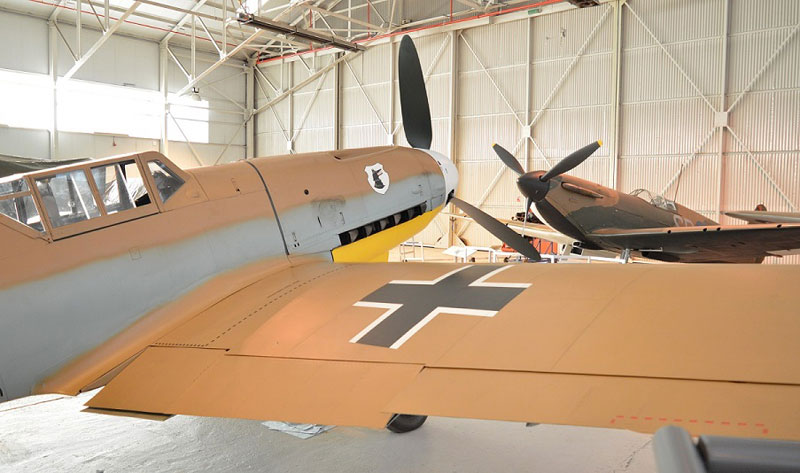
A Messerschmitt BF109G-2 and a de Havilland Tiger Moth II, are the first of six new aircraft to arrive at the Royal Air Force Museum Cosford, having been transported by road from the museum’s sister site in London.  Visitors can now view the brand new arrivals on display in the museum’s hangars with four more aircraft due to arrive before Christmas.

The Messerschmitt BF109G-2, designed by Willi Messerschmitt, is a legend alongside the British Spitfire, American P51 Mustang and the Japanese Zero.  First flown in 1935, the Bf109 was obsolescent by the second half of World War Two yet it remained the backbone of the German Air Force’s day fighter force and was flown by many of her allies. In production right up to the end of hostilities, more than 33,000 were built second only to the Russian ‘Sturmovik’ as the most prolific military design, and post-war versions served with the Czech, Israeli and Spanish Air Forces, the latter until the mid-1960s – with Rolls Royce Merlin engines.  Compact, rugged, fast and heavily armed the Bf109 has the distinction of being flown by the highest-scoring fighter aces in history. With the promised availability of the new Daimler-Benz DB 605A German built engine, design work began on the Bf109G series where higher speeds were obtained, but manoeuvrability and handling were adversely affected. The Bf109G series will be forever linked with the daylight bomber-killing missions in defence of the Reich. German fighter pilots found themselves facing heavily armed American B17 Fortress and B24 Liberator bombers and later long range P38 Lightning, P47 Thunderbolt and P51 Mustang fighters. Ground down by the overwhelming odds, few survived the war. 

The museum’s rare example was disassemble by the museum’s team of Aircraft Technicians and Apprentices in London and transported on a low loader lorry along the M1, M6 and M54 before being reassembled in its new display hangar at Cosford. Members of the public can now view the aircraft in the museum’s ‘War in the Air’ hangar alongside fellow German fighter the Focke Wulf Fw190, facing their British equivalents the Supermarine Spitfire 1 and Hawker Hurricane IIc.

The second of the two new arrivals is the 1930s bi-plane the de Havilliand Tiger Moth II, originally produced as a development of the well-known Gipsy Moth.  The Tiger Moth went on to become one of the world’s most famous training aircraft and provided the majority of RAF pilots with their elementary flying training during the Second World War.  In the aftermath of the Dunkirk evacuation in 1940, almost any anti-invasion idea was considered and three extraordinary Tiger Moth conversions were put forward.  Some were fitted with light bomb racks ready to undertake the bombing of enemy troops attempting a landing, whilst others were fitted with a tank in the front cockpit with powder dispensers located under the wings intended to dust the German troops with a poisonous insecticide as they waded ashore.  A more revolutionary idea was the ‘paraslasher’; a scythe-like blade fitted to the aircraft and intended to cut parachutist’s canopies as they descended to earth. Fortunately none of these ideas had to be used, leaving Elementary Flying Training Schools to their vital role of pilot training. 

The Tiger Moth was eventually succeeded and replaced by the de Havilland Chipmunk in the early 1950s and both aircraft can now be viewed alongside each other in Hangar 1 at Cosford, positioned next to the Scottish Aviation Bulldog T Mk 1, a further progression in training aircraft.  The Tiger Moth also travelled by road to Cosford, alongside the Bf109 .

Other aircraft still to wing their way to Cosford before Christmas include the Wolverhampton built Boulton Paul Defiant M1, Junkers Ju 88R-1, Gloster Gladiator 1 and the Westland Lysander III.  Work is already underway at the museum’s London site to prepare the aircraft for transportation by road to Cosford.  Visitors will be able to see all of the new aircraft fully reassembled and in their new display positions by early 2017, with the exception of the Lysander which will spend a short period in the museum’s Conservation Centre before eventually going on display.

RAF Museum Cosford Curator, Al McLean said:

“This will be the first time that we have been able to display a Bf 109 in the War in the Air hangar at Cosford and appropriately it will be seen confronting a Hurricane and a Spitfire.”

The new aircraft arrivals will enable the RAF’s story to be more comprehensively represented to museum audiences in Shropshire, as the museum prepares to celebrate and commemorate the centenary of the Royal Air Force in 2018.  Whilst there are major transformations planned for the museum’s London site, some exciting additions for Cosford will include exploring the first 100 years of the RAF, the role it plays today and its future contributions, as well as sharing the story online with a global audience.

Aviation fans can keep up to date with the centenary aircraft moves and on-going developments by signing up to the museums free e-Newsletter http://www.rafmuseum.org.uk/contact-us/newsletters.aspx

Entrance to the museum is free of charge and the museum is open daily from 10am until 4pm.  For further information, please visit the museum’s website www.rafmuseum.org/cosford.
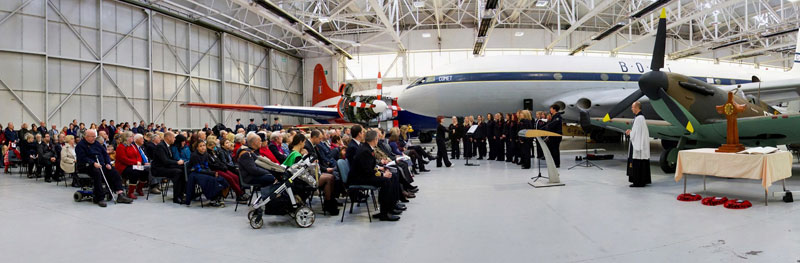
Visitors invited to join Remembrance Service at Cosford

RAF Museum Cosford Remembrance

Date: Sunday 13 November

Time: 10.30am

On Sunday 13 November, the Royal Air Force Museum Cosford will hold a Service of Remembrance, paying respect to those service men and women who made the ultimate sacrifice during their tours of duty. 

Visitors who wish to pay their respects and reflect on the sacrifices made by our brave service men and women are invited to join the service, led by Rev (Sqn Ldr) Andrew J L Chapman, Station Chaplain RAF Cosford.    Those attending will also be treated to renditions from the Cosford Military Wives Choir, who will perform for visitors on arrival and during the service. 

The service will take place in the museum’s Hangar 1 and visitors are politely requested to assemble no later than 10:30am ready for the Service to commence at 10.45am.  As well as readings from museum volunteers, there will be hymns and the sounding of ‘The Last Post’, followed by a two minute silence.

RAF Museum Cosford Events Manager, Abi Betteridge says:

“The RAF Museum is a fitting location for this poignant occasion and we hope that local residents will choose to join us on Remembrance Sunday so we can remember together.  I would like to thank the Station Chaplain and the Cosford Military Wives Choir for their involvement in this years’ service. I’m sure visitors will enjoy the special service we have planned as well as the performances from the choir.”

 During the service, wreaths will be laid by representatives from RAF Cosford, the museum and a Second World War veteran in honour of those who have fallen in the line of duty. Following the service visitors are free to explore the museum at their own leisure.

If you would like to find out about Service Personnel who fell serving in the Royal Flying Corps and the Royal Air Force during the Great War of 1914 to 1918, or to dedicate a digital poppy, please visit the RAF Museum’s online story vault: www.rafmuseumstoryvault.org.uk

The museum is open daily from 10am to 4pm and entry to the museum is FREE of charge.  For further information please visit www.rafmuseum.org/cosford.

RAF Museum concludes 2016 lecture series

br Bruce Mackay

Academics, military enthusiasts and interested members of the public are being invited to attend two forthcoming lectures next month, concluding the 2016 series of lectures from the Royal Air Force Museum’s Research Programme.

‘The Development of RAF Air Power Doctrine, 1999-2013’

Date: 10 November 2016

Time: 6.30pm

Cost: FREE

Location: University of Wolverhampton, MC001, Millennium City Building, Wolverhampton Campus.

The first of two lectures is being held on Thursday 10 November at the University of Wolverhampton and is a continuation of the joint partnership between the University’s Department of War Studies and the Royal Air Force Museum. This evening lecture commencing at 6.30pm will examine how the Royal Air Force has adapted to the post-Cold War strategic environment and the influencing factors that have contributed to the change in military doctrine. The lecture entitled ‘The Development of RAF Air Power Doctrine, 1999-2013’ will be presented by Dr Viktoriya Fedorchak, an independent researcher who recently completed her PhD on the subject.

Dr Viktoriya Fedorchak will discuss the variations in the RAF’s policies over the last two decades and the role it has played in the development of the Service’s doctrine and the evolution of air power. It will consider the four major factors in doctrine preparation; operational experience, internal politics, the role of academics and the doctrine writer. Furthermore, Dr Fedorchak will discuss how new campaigns provided operational lessons and how the shift from a single-service to a joint authorship resulted in the change of purpose and functionality.

Dr Peter Preston-Hough, from the University’s Department of History, Politics and War Studies, said:

“We’re delighted to be co-hosting this prestigious series of lectures, which continues to provide an interesting insight into this fascinating area of history. This lecture is a topical analysis of the RAF’s history during an important and very recent period of political and military change.”

‘Coming to Terms with the Air-Atomic Age’

Date: 18 November 2016

Time: 12.30pm

Cost: FREE

Location: RAF Museum Cosford, National Cold War Exhibition Lecture Theatre

On Friday 18 November, Colonel Edward A. Kaplan, Director of Aerospace Studies in the Department of National Security and Strategy at the U.S. Army War College will be presenting the final Cold War lunchtime lecture, being held in the Museum’s lecture theatre at 12.30pm. Entitled ‘Coming to Terms with the Air-Atomic Age’ Colonel Kaplan looks at the notion that air power makes unique and potentially decisive contributions to national security and how this can have different meanings over time. He will illustrate these shifts using the history of the first twenty years of post-Second World War strategic air power, the “air-atomic age”.

He will explore the shift from an early air-atomic period where American strategic air power sought to destroy enemy industry, through a later period that prioritised blunting a Soviet nuclear offensive, to the rise of Mutually Assured Destruction. The latter idea abandoned conventional notions of victory and substituted signalling an enemy through violence with a final fallback of punishment. Civilians seized control of these air operations to support these efforts to signal or punish an enemy, undermining the professional standing of Airmen. As a result, airpower began a search for a new identity that ultimately led to the substitution of precision for blunt force and the restoration of operational control to professional Airmen.

Dr Ross Mahoney, RAF Museum Aviation Historian said:

“The final two lectures of the RAF Museum’s Research Programme for 2016 examine two fascinating areas related to the development and importance of air power on both sides of the Atlantic. They should be of interest to those interested in the development of air power since the Second World War to the present. Also, we are pleased to be running our Trenchard Lectures with our partners at the University of Wolverhampton who continue to support the series.” 

As spaces are limited to both lectures, organisers advise visitors to book their FREE tickets in advance via the museum’s website to avoid disappointment www.rafmuseum.org/cosford.  Additional information about both lectures and the Museum’s Research Programme is also available online.

Visitors arriving early for the ‘Coming to Terms with the Air-Atomic Age’ lecture being held at the museum’s Cosford site can also take up the opportunity to see inside the Museum’s Conservation Centre during the annual open week which runs from 14-19 November. Doors to the Conservation Centre open at 10.15am until 1.00pm and entry is just £5 per person. 

Red Arrows Gnat and Hampden fuselage are open week highlights

Red Arrows Gnat

Date: 14-19 November 2016

Time: 10:15am-1:00pm

Cost: £5.00 per person

A newly painted Vickers Wellington bomber wing, the Handley Page Hampden fuselage and a Red Arrows Gnat are just three of the aviation treasures on show to visitors next month at the Royal Air Force Museum Cosford’s Conservation Centre Open Week. 

An exciting highlight to this year’s open week is the newly fabric covered and painted Vickers Wellington bomber outer wing.  This popular aircraft is a favourite with aviation fans and has undergone work to treat small amounts of corrosion to its famous geodetic framework, both wings and fuselage, since its arrival at Cosford in June 2010.  Now free of corrosion, both wings have been painted in a protective layer and in the last 6 months, one of the wings has been re-covered in Irish linen, doped and painted in its Bomber Command Night colour scheme by one of the museums Aircraft Technicians.  Work is now underway to repeat the process on the aircrafts second wing and eventually the fuselage.  Initially a five year project, the Wellington is expected to be completed within the next two to three years.

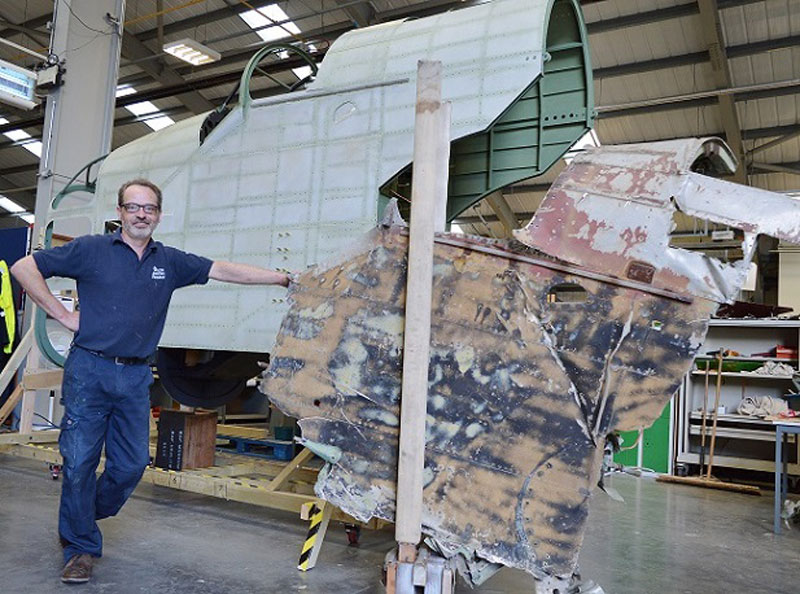
The team in the museums Conservation Centre are also lining up another treat for visitors, quite literally.  For the first time ever all four sections of the Handley Page Hampden’s fuselage will be placed in line showing an almost fully complete Hampden silhouette.  Work has been advancing on the Hampden considerably over the last 12 months and large sections of the badly damaged aircraft have been built from scratch on site at Cosford.  Since it was last viewed by the public almost 12 months ago, the forward fuselage and cockpit section has been manufactured using pre-production drawings and where possible castings and a few components from the original P1344 Hampden have been incorporated.  The new section will be placed alongside the rear fuselage, tailboom and tailplane for visitors to get an up close view of this rare example.  All effort on the aircraft is going into manufacturing the fuselage section which is hoped will be completed sometime in 2018.

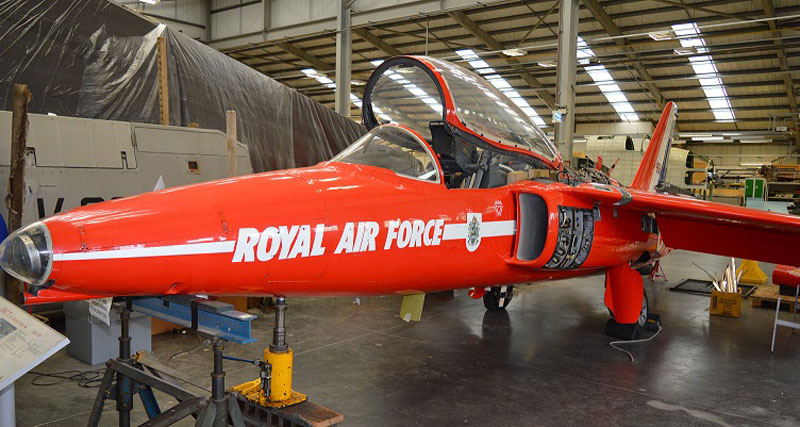
Another aircraft spending a short period of time in the Conservation Centre is the Hawker Siddeley Gnat T1 – the first aircraft used by the RAF Red Arrows, superseded by the current aircraft, the Hawk in 1979.  The aircraft was previously on public display at Cosford and was moved into the Conservation Centre in June.  The aircraft is destined to move to the museum’s London site in 2017 and the open week in November is a last chance for Red Arrow fans to see the aircraft in the West Midlands.  As the aircraft is being prepared for transportation by road, it is also a chance to see it in a partial stripped condition.  

RAF Museum Conservation Centre Manager, Darren Priday said:

“With the museum fully engrossed in the RAF Centenary Programme the Conservation Centre team have spent a lot of 2016 away from Cosford at our London site preparing aircraft for moving. Another task that has taken us away from home is the Spitfire XIX that is currently on display in the Bahrain National Museum, the forth location it has been on display in the Middle East country in 2017.  With all these task going on away from Cosford it would have been easy to ‘down tools’ on the long term projects, but we haven’t.  The Wellington wing with its new covering and surface finish is a work of art.  In respect to the Hampden, regular visitors will notice how much the forward fuselage section has come on since last year’s open week. The chance to line up all four fuselage sections was something I have been looking forward to for a long time.  Finally the time has come and we will be able to show a Hampden fuselage in the UK; the last time this would have happened would be over 70 years ago.  We look forward to greeting our repeat visitors but also a warm welcome awaits anyone visiting for the first time”.

 Visitors will also be able to view the continuing progress on the Range Safety Launch, a project being led by a team of Volunteers, plus see a glimpse of the Dornier Do 17.  Now clear of all the marine crustaceans, the Dornier is currently housed in a controlled environment with de-humidifiers whilst the museum awaits further advice from the project advisor on how best to treat the metal. 

Museum Technicians, Apprentices and Volunteers will be available throughout the week to speak with visitors about their work and answer any questions they may have.  In addition, from Wednesday through to the Saturday, family members of the crew from the museum’s ill-fated Hampden’s last flight will be in-attendance. 

The Conservation Centre will open from 14-19 November between 10.15am and 1.00pm each day and admission is £5.00 per person (children under 16 are free and must be accompanied by an adult).  The Museum’s other hangars will be open from 10am until 5pm and entry to the museums is free of charge.  For further information, please visit the museum’s website www.rafmuseum/cosford or call 01902 376200.

PLUS…in addition to the open week, visitors will also have the exciting opportunity to climb on board the Hawker Siddeley Nimrod R.1 XV249 during daily tours.  Tickets are available to purchase on arrival, for more details visit the museum website.

New aircraft arrivals heading to Cosford

PBY Catalina

The Royal Air Force Museum Cosford will be welcoming a collection of new aircraft to the site later this year as it prepares to celebrate and commemorate the centenary of the Royal Air Force in 2018.  New arrivals will include a Wolverhampton built Boulton Paul Defiant Mk 1, the last surviving example of its kind, plus a rare Messerschmitt BF109G-2.

As the RAF and family of RAF charities work towards celebrating a century of service, plans at the RAF Museum are already underway for a major transformation of its London site, with aircraft movements and some exciting new additions making their way to Cosford.  The centenary plans will also include exploring the first 100 years of the RAF, the role it plays today and its future contributions by sharing this story online with a global audience.

In preparation for 2018 there are a number of aircraft moves due to take place at both the museum’s London and Cosford sites in order to deliver the interpretation planned. The planned moves will see the largest single influx of new aircraft at Cosford since the National Cold War Exhibition building was opened in 2007, as six new aircraft are scheduled to arrive before Christmas.  As part of the centenary plans, Cosford will receive six aircraft from the collection in London, enabling the RAF’s story to be more comprehensively represented to museum audiences in Shropshire.

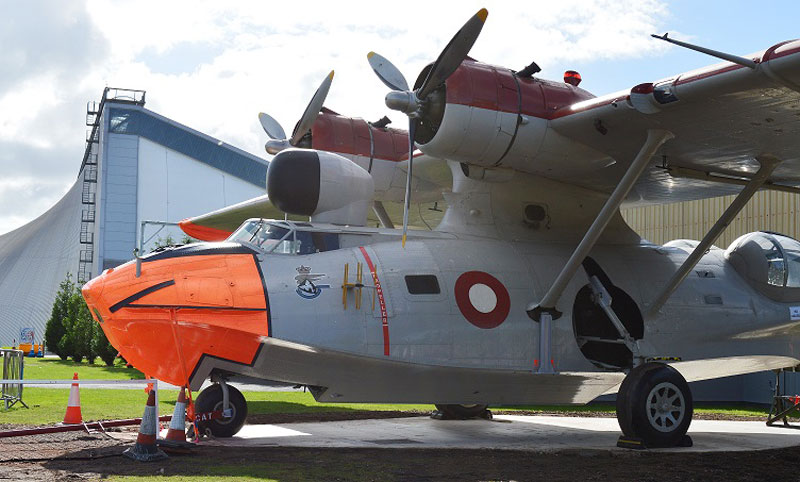
Over the coming months, visitors at Cosford will notice a number of aircraft movements and work is already underway to make room for the new arrivals.  In September the Consolidated PBY-6A Catalina was moved out of the War in the Air Hangar and placed on temporary external display at the entrance to the ‘History of the RAF’. The museum has also begun looking into long term plans for the site at Cosford to ensure that all aircraft, including any future arrivals are displayed undercover.

In addition to the Messerschmitt BF109G-2 and the Boulton Paul Defiant Mk 1, other new aircraft heading to Shropshire before the end of the year include the Junkers Ju 88R-1, a sub-type of the most versatile German combat aircraft of the Second World War, and the Gloster Gladiator 1, the first enclosed cockpit and last biplane fighter introduced into RAF service.  Following re-assembly, all four aircraft will go on public display in the museums ‘War in the Air’ hangar.

Also included in the new line-up is the de Havilland Tiger Moth II, one of the world’s most famous training aircraft which provided the majority of RAF pilots with their elementary flying training during the Second World War.  The Tiger Moth will be displayed next to the de Havilland Chipmunk and Scottish Aviation Bulldog T Mk 1 in Hangar 1, demonstrating progression in training aircraft.

Finally, the Westland Lysander III, the only surviving Special Duties variant of this aircraft (which were used to ferry allied agents in and out of enemy occupied Europe) will be heading to the museum’s Conservation Centre for an in depth inspection and condition assessment.  The Lysander will join other conservation projects which include the Wellington Bomber and the Handley Page Hampden and work will be carried out over the next few years to replace its fragile linen outer skin.

Head of Collections at the RAF Museum, Ian Thirsk said:

“The museum’s centenary plans have provided an exciting opportunity to relocate significant aircraft in the collection closer to our Midlands audience.  I’m particularly delighted that our Boulton Paul Defiant, an aircraft with such strong local links to Wolverhampton, will be going on public display at Cosford for the first time. Additionally, the arrival of the Junkers Ju 88 R-1 and Messerschmitt BF109G-2 will enhance our existing display of Axis Second World War aircraft, several of which are the last remaining examples of their type in the world.”

To make way for the new arrivals, the de Havilland Venom FB4, FMA IA58 Pucara and Folland Gnat F1 have all been moved into the museum’s storage facility on the airfield.

Work is already underway at the museum’s London site to disassemble the aircraft and prepare them for their journey by road to Cosford.  Aviation fans can keep up to date with the centenary aircraft moves and on-going developments by signing up to the museums free e-Newsletter http://www.rafmuseum.org.uk/contact-us/newsletters.aspx

Visitors will be able to see five of the new arrivals fully reassembled and in their new display positions by early 2017.  Entrance to the museum is free of charge and the museum is open daily from 10am until 5pm.  For further information, please visit the museum’s website www.rafmuseum.org/cosford or call 01902 376200.

Experience the virtual skies at Cosford

Flight Sim at RAF Museum Cosford

Date: 8 October 2016

Time: 10:00am to 5:00pm

Cost: £7 in advance / £10 on the door

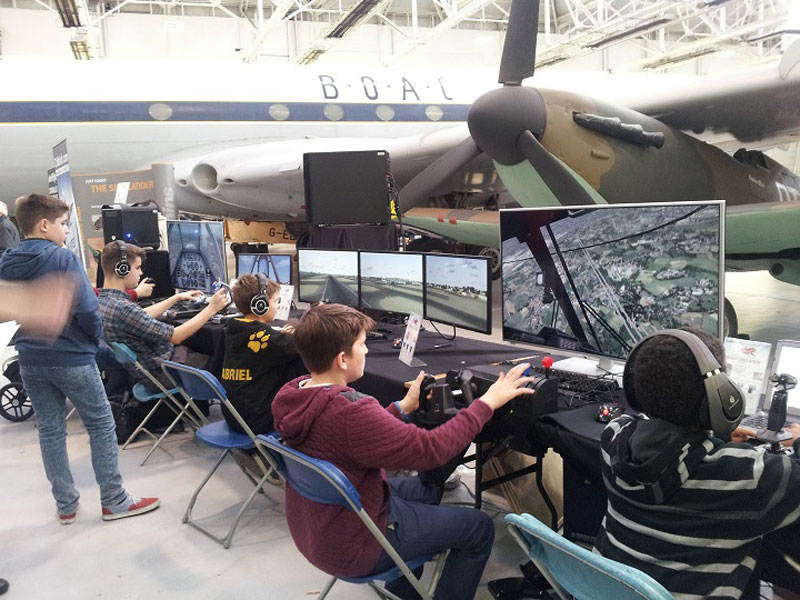
Aviation fans can experience the virtual skies in Shropshire next month as the Flight Sim 2016 event heads to the Royal Air Force Museum Cosford.  Taking place on Saturday 8 October, aviation enthusiasts will enjoy a day packed with all the latest flight simulation software and the chance to test out their virtual flying skills.

After three very successful shows held at the museum, the UK’s largest Flight Sim show will be returning to Cosford for an even bigger and better event. Just Flight, one of the UK’s leading flight simulation software publishers, will be hosting this major gathering in association with PC Pilot magazine to show visitors the very best in desktop flying.  Building on the success of previous events, organisers are anticipating in excess of 1,500 visitors will attend the one day show.

Visitors will be able to get hands on and fly the latest flight simulation aircraft, preview ‘in development’ projects, check out the latest hardware and chat with leading developers, publishers and other enthusiasts in addition to the many exhibitors at the show.

This show will take place in the museum’s Hangar 1 from 10am until 5pm, giving visitors plenty of time to enjoy the wide range of entertainment on offer.  So whether you’re a veteran desktop pilot, flight simulation novice, or someone thinking of getting airborne in the virtual skies for the first time, there will be something for everyone to enjoy. 

Visitors attending the Flight Sim 2016 event this autumn will experience the best of both, the virtual world and the real world of aviation, as they explore the world class collection of aircraft and exhibitions on display at the RAF Museum Cosford.

Advance tickets for Flight Sim 2016 are now on sale online for just £7 per person and can be purchased up until 6 October, with free entry for under 16s accompanied by an adult. Advanced ticket holders will also receive a free goody bag on arrival which includes; a boxed add-on from Just Flight, a Dovetail Games code for a free add-on, an Aerosoft code for a discounted product, a copy of PC Pilot and a Pro-Sim Air stress ball!

Tickets purchased on the day cost £10 per person. For further information on the event or to purchase your tickets in advance, please visit the show’s website www.flightsimulatorshow.com .

To cope with the additional visitors, a free park and ride will operate from Cosford train station with regular pickups throughout the day.  Entry to the museum is free of charge and on-site parking is available (charges apply). Entry into Hangar 1 on Saturday 8 October will be for Flight Sim 2016 ticket holders only.

www.rafmuseum.org.uk

Hampden bomber gets new lease of life

Hampden bomber

A rare example of a Handley Page Hampden being restored at the Royal Air Force Museum Cosford is making huge steps towards completion of the fuselage section.   As one of the Museum’s longest running conservation projects, the aircraft is starting to take shape now thanks to one of the museum’s skilled Aircraft Technicians who is building a large section of the aircraft from scratch!

The museums Hampden, serial number P1344 is one of only three examples of the type remaining and was recovered from a crash site in northern Russia in 1991 and acquired by the RAF Museum the following year.  Restoration on the badly damaged airframe has been a slow labour of love for the team at Cosford, but since it was taken under the wings of full time Aircraft Technician Dave Carr 18 months ago, the project has been propelled and the unmistakable Hampden silhouette can now easily be recognised.  

With the project now stepped up a gear, visitors who viewed it during last year’s open week just ten months ago will remember seeing the tailplane assembly, a predominantly new build manufactured on site at Cosford.  The Hampden’s salvaged fin and rudder parts were fully restored and with little else of the original tailplane remaining following the aircrafts crash landing, Dave used pre-production drawings and built formers to create the components he needed including a new elevator.  Following the build, the rudders received a new covering of Irish linen and the tailplane assembly was given a new coat of paint in its initial Bomber Command camouflage colour scheme; the assembly was well received by aviation fans who visited during the open week last November. 

Eagle eyed visitors will have also noticed that work had just started on the forward fuselage and the beginning of the frame work was starting to take shape.  Since then Dave has focussed his efforts on the forward fuselage and cockpit section and in just twelve months the section is now almost 75% complete and is estimated to be fully manufactured by Spring 2017.  Work on this section began with creating formers and building the entire framework from scratch.  Some components including instrument panels, seat mounting and windscreen frames have also been produced and fitted. Castings and a few components from P1344 have been restored and fitted to the newly built forward fuselage and work is now underway skinning the section.

The entire new section has been assembled using original Handley Page pre-production drawings from the late 1930s and where possible, measurements taken from the partial wreckage remaining from the original aircraft.   As the build procedure for the Hampden is not documented on any of the original drawings, the build has required a lot of forward thinking to ensure components were fitted in the correct order, as not to cause complications further down the line. 

RAF Museum Aircraft Technician, Dave Carr said:

“I have worked at the RAF Museum for over 18 years and this has by far been the biggest project I have worked on from a scratch build point of view; usually we are conserving and repairing aircraft. Because I don’t have a build procedure, I always have to work about five steps forward to ensure the correct components are fitted before the aircraft is skinned i.e. anchor nuts, brackets etc. It is being constructed as accurately as possible, although there will be some subtle differences as I’ve had to manufacture with hand tools and limited machinery, rather than the original factory machinery which doesn’t exist anymore. It’s very rewarding and motivating to see the aircraft coming together.”

The lower forward frame work is still to be complete as well as frame work for the nose section followed by the instillation of electrical and hydraulic components.  An original Hampden seat salvaged from a crashed Hampden in Patricia Bay, Vancouver will also be incorporated into the new cockpit.  Once complete, the next phase will see the new section programmed into the museums paint shop where it will undergo a full re spray to match the tailplane.

All effort on the aircraft is going into manufacturing the fuselage section which is hoped will be completed sometime in 2018.

Visitors to the museum will be able to view the continuing progress on the Hampden during the Conservation Centre Open Week from14-19 November.  By November it is hoped that the lower longerons will have been manufactured and fitted to the forward fuselage so visitors will see an almost fully complete frame.  Work is also continuing on the rear fuselage repairing damage caused during its crash landing.  The Conservation Centre will open between 10.15am and 1.00pm each day and admission is £5.00 per person (children under 16 are free and must be accompanied by an adult).

The Museum’s other hangars will be open from 10am until 5pm and entry to the museums is free of charge.  For further information, please visit the museum’s website www.rafmuseum.org/cosford or call 01902 376200.

Roald Dahl and his RAF journey to literacy stardom

Graham Laurie

Date: 10 September 2016

Time: 2pm

Cost: £5 per person (recommended for families with children aged 10 and over)

One of Britain’s most iconic writers, Roald Dahl will be the focus of a talk taking place at the Royal Air Force Museum Cosford next month.  Celebrating the 100th birthday of Roald Dahl, the talk entitled ‘Roald Dahl’s War’ will delve into his life before he became an iconic writer, including his career in the RAF.  Presented by historian Graham Laurie, the talk will take place at 2pm on Saturday 10 September 2016.

During this talk, Graham will examine Roald Dahl’s career from the moment he left school through to his employment with the oil company Shell, his first overseas post in Africa and his life in the Royal Air Force.  Dahl eventually went on to become a giant in the world of children’s books, making characters like ‘The BFG’, ‘Matilda’ and ‘Charlie and the Chocolate Factory’ household names for millions of children. 

So famous were his popular novels, Dahl’s Royal Air Force career is often one that’s over looked.  Following the outbreak of World War Two in 1939, at the age of 23 Dahl enlisted in the RAF and quickly began his training in Tiger Moths.  Once qualified, he travelled to Iraq for advanced training on Hawker Harts and was commissioned as a Pilot Officer in the RAF Volunteer Reserve and posted to 80 Squadron based in North Africa.

In 1940 on a flight to deliver new aircraft to his Squadron on the coast, Dahl came into difficulties and was forced to make a landing during which the aircraft overturned.  As a result he suffered severe head and back injuries requiring almost six months recovery in a British military hospital in Alexandria, Egypt.  The following year he re-joined 80 Squadron near Athens, Greece, flying a Hurricane Mk 1 and went on to take part in ‘The Battle of Athens’.  After suffering debilitating headaches as a result of his crash in Libya and no longer able to fly, Dahl returned home to Britain and was discharged from the RAF. 
This illustrated talk contains many of Dahl’s own photographs and is given by kind permission of The Roald Dahl Museum and Story Centre.  The talk will take place at 2pm on Saturday 10 September, just three days before what would have been Roald Dahl’s 100th birthday.  Places are limited so anyone interested in attending is advised to book their place now via the museum’s website www.rafmuseum.org/cosford.  Spaces on the day will be subject to availability.
The insight into Dahl’s military career and life before his famous books will be presented by guest speaker Graham Laurie. Now a historian and an ambassador of the RAF Benevolent Fund, Graham was a pilot in the RAF for 36 years and during the latter half of his career he flew members of the Royal Family and senior government ministers. 

RAF Museum Cosford Events Manager Abi Betteridge said:

“We are looking forward to celebrating 100 years of Roald Dahl here at the RAF Museum Cosford and honoured to be able to share the stories of his time serving in the RAF with our visitors.  He was such a significant writer to children and adults alike and we look forward to our guest speaker, Graham Laurie telling us more about a side to the author many people know little about.”

Admission to ‘Roald Dahl’s War’ lecture is £5 per person and is recommended for families with children aged 10 and over.  For further information or to book your place visit: www.rafmuseum.org/cosford.  The museum is open daily from 10am and entry to the museum is FREE of charge.

Spitfire 10K – Countdown to race day

RAF Museum Spitfire 10k run

Date: 4 September 2016

Time: Race starts at 10am

Cost: Standard entry £22.50 per person (15 years & over)

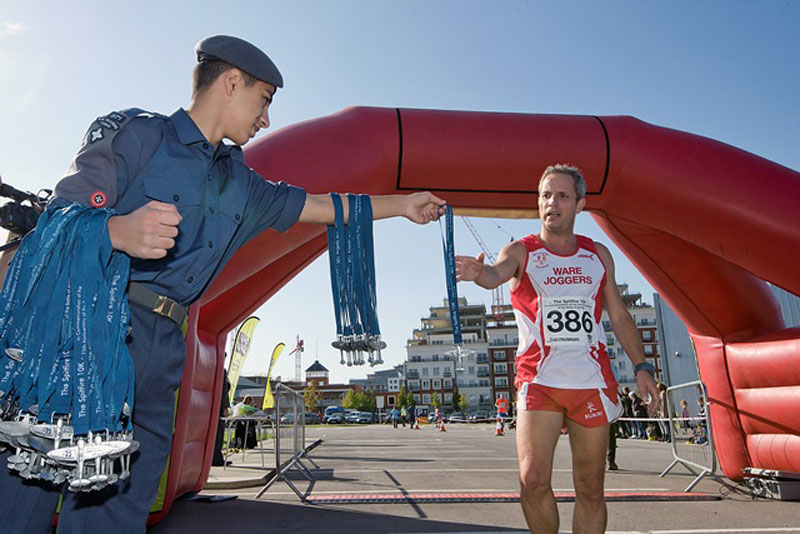
The countdown has officially started for the first ever Spitfire 10K!  Taking place at the Royal Air Force Museum Cosford in just under two weeks’ time, this unique sporting event will see hundreds of runners’ race across the airfield and down the runway before crossing the finish line and picking up a specially commissioned Spitfire medal. This charity run, raising funds for the RAF Museum (registered charity No. 244708) will take place on Sunday 4 September, where over 600 runners are already signed up to take part. 

Participants will head to the start line and begin their race in the museum’s spacious grounds, before setting off onto the adjacent military airfield to complete part of their 10K race.  Exclusively for this event; participants will run the scenic route past the wartime hangars, alongside the air traffic control tower and even down the runway!  Runners are advised to arrive from 9am in order to collect their race number and warm up, then its chocks away at 10.00am as the race begins. 

Whether you’ve been running for years, or you’re just getting into the sport for the first time, the race at Cosford is guaranteed to be a fun and memorable one.  The Spitfire 10K is a gently undulating road course with small sections along a track and is suitable for keen runners and novices alike, so if you’re aged 15 and over why not give it a go? 

There will be specially commissioned winner’s trophies up for grabs in a variety of categories in addition to the unique Spitfire medal that all runners will receive upon crossing the finish line.  Participants will also receive a goody bag filled with goodies thanks to some event sponsors, including a much needed bottle of Radnor Hills mineral water to quench your thirst and a pack of Willy Chase’s Fit Popcorn to pick up your energy levels after the race.  Plus, the museums onsite caterers Kudos have supplied a muffin bar for every runner and bags will also include a 20% discount voucher to spend on the day in the museum shop.

As a memento of the day, bespoke 2016 Spitfire 10K technical running t-shirts will be available to purchase on race day for just £10, with limited stocks available.  Made from breathable fabrics, they make the perfect attire for race day and for running adventures beyond. 

So with the race just days away, if you haven’t already registered and you want to take part, visit the museum’s website www.rafmuseum.org/cosford to book one of the last few places remaining.  Entry costs £22.50 per person with proceeds going towards the RAF Museum (registered charity No. 244708), to support work conserving and sharing the story of the RAF for current and future generations.  Armed Forces Personnel and running clubs are eligible for the discounted entry fee of £20.50 per person. 

(The Spitfire 10K was first launched at the museum’s London site in 2015)

Museum evening event is plane marvellous!

FD2 RAF Museum Cosford

Date: 16-17 September 2016

Time: 6.00pm to 9.00pm

Cost: £12.50 per person

The doors to military aircraft spanning a history of more than eight decades will be opened up to visitors at the Royal Air Force Museum Cosford next month during a special two night event.  Aviation fans will be able to view inside a total of fifteen aircraft, with everything from Cold War mainstays to unique prototype jets that pioneered the way for many of the world’s most iconic defence aircraft.  Taking place on 16-17 September, just 300 tickets per evening are available for those who want to make their visit to the museum extra special.

 Visitors can marvel at the advanced technologies on unique airframes including the TSR2, one of the most exciting and controversial British combat aircraft designs of the 1960s.  Despite its outstanding technical success, political opposition led to the project being cancelled in April 1965 and the TSR2 is still a subject of great debate to this day.  Arguably the most popular and advanced aircraft of its time, the TSR2 is still a popular favourite with aviation fans and is sure to be a highlight on the night.

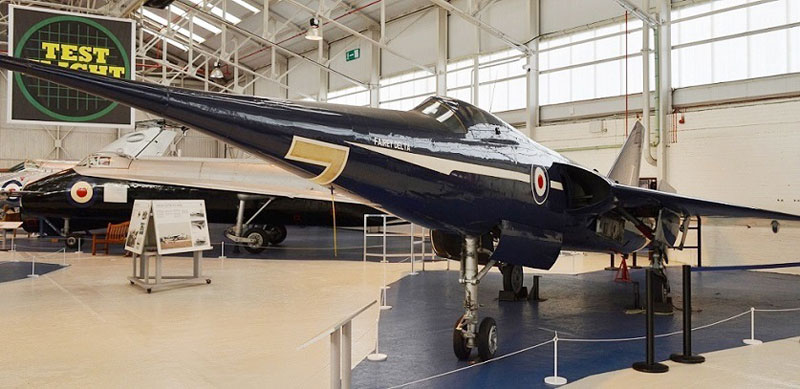
The Fairey Delta 2 (FD2), one of only two ever built will also be opened up to ticket holders. Designed during the late 1940s in a bid to retrieve Britain from trailing in supersonic aircraft design, the FD2 later went on to break the World Air Speed Record in 1956 reaching 1132mph, breaking the record set only the year before by over 300mph.  One of its unique features was the aircrafts ability to tilt the cockpit and nose section down by ten degrees in order to improve the pilot’s forward view during landing, taxiing and take-off.  Visitors can learn more about its capabilities by speaking with staff and volunteers on the night, ensuring they get the most out of their visit.

Over in the museum’s National Cold War Exhibition a collection of aircraft that were the backbone to the west’s successes during the Cold War period will also be available.  Aviation fans will be able to take a seat inside the cockpit of the sturdily built nuclear-capable Blackburn Buccaneer S1 nose section flown by the Royal Navy and the United States Air Force’s General Dynamics F-111, a combat aircraft capable of altering its wing configuration in flight to adjust the aerodynamic properties. Plus, the giant Short Brothers Belfast used by the RAF for almost twenty years, capable of carrying 150 fully-equipped troops or two Wessex helicopters will be opened exclusively for ‘Open Cockpits Evening’.

During the event, ticket holders will also have exclusive after-hours access to the museum which displays a collection of over 75 aircraft, military vehicles, engines and aviation artefacts within three wartime hangars and the National Cold War Exhibition.  Other aircraft available on the night include: Hawker Siddeley Andover, Avro Anson C.19, Scottish Aviation Bulldog T Mk1, Hunting Percival Pembroke C1, SEPECAT Jaguar ACT Demonstrator, Saunders-Roe SR53, Hunting H126, McDonnell Douglas Phantom FG.1, Hawker Hunter F.4 and the Scottish Aviation Twin Pioneer.  This mix of aircraft means there is something to suit the interests of all enthusiasts and young aviators alike.

Tickets are now available to purchase through the museum’s website www.rafmuseum.org/cosford and cost £12.50 per person which includes parking (minimum height restrictions of 1.07 metres will apply).  A full list of aircraft available on the night is also available online. The Museum will close at 5.00pm both days, however the Visitor Centre and Refuel Restaurant will remain open prior to the event which commences at 6.00pm and finishes at 9.00pm.